Why Do Manufacturers Struggle Without a CRM? 10 Warning Signs
Manufacturers struggle without a CRM when quotes stall and data stays siloed. See 10 warning signs your business has outgrown spreadsheets.
Contact Us
Manufacturers struggle without a CRM because customer knowledge stays scattered across spreadsheets, inboxes, ERP screens and individual reps' memories. The result is slow quotes, missed reorders, unreliable forecasts and distributor sales nobody can track.
A CRM fixes this by giving sales, service and operations one shared record of every account, quote and conversation. Here are 10 warning signs your business has outgrown spreadsheets.
What Is a Manufacturing CRM, and Why Isn't ERP Enough?
A manufacturing CRM manages the customer side of your business like accounts, contacts, opportunities, quotes, distributor relationships and service cases. ERP manages the operational side: bills of materials, production orders, inventory, procurement and invoicing.
Both systems touch the customer, but they answer different questions.
| CRM | ERP | |
|---|---|---|
| Core question | Who are we selling to, and what will they buy next? | How do we build, ship and bill it? |
| Main users | Sales, marketing, customer service, channel managers | Production, procurement, warehouse, finance |
| Key records | Leads, opportunities, quotes, activities, service cases | Sales orders, BOMs, work orders, inventory, invoices |
| Time focus | Before the order and after delivery | From order to cash |
| Common platforms | Microsoft Dynamics 365 Sales, Salesforce Manufacturing Cloud, HubSpot, Zoho CRM | SAP S/4HANA, Dynamics 365 Business Central, Oracle NetSuite, Epicor |
The two work best together. When your CRM connects to your ERP, sales reps see pricing, stock levels, order status and credit limits without calling the back office. Operations, in turn, sees what sales expects to close next quarter.
Why Manufacturing Companies Need Smarter CRM in 2026
Is your manufacturing CRM ready for 2026? Discover how smarter CRM systems boost sales, improve forecasting, and strengthen customer relationships.
Read MoreWhy Manufacturing Sales Breaks Down Without a CRM
Manufacturing sales carries more moving parts than most B2B sales. Four traits make it hard to run on spreadsheets and memory:
Most manufacturers invested first in ERP and shop-floor systems, while the front office ran on email and Excel. The result shows in the data. In a February 2026 Adobe and Incisive survey of 559 industrial manufacturing leaders, 97% said their customer data is siloed or only partially integrated, and just 1% reported fully integrated, accessible customer data (Adobe).
Most of those respondents run billion-dollar enterprises. A mid-sized manufacturer faces the same gap with fewer people to cover it.
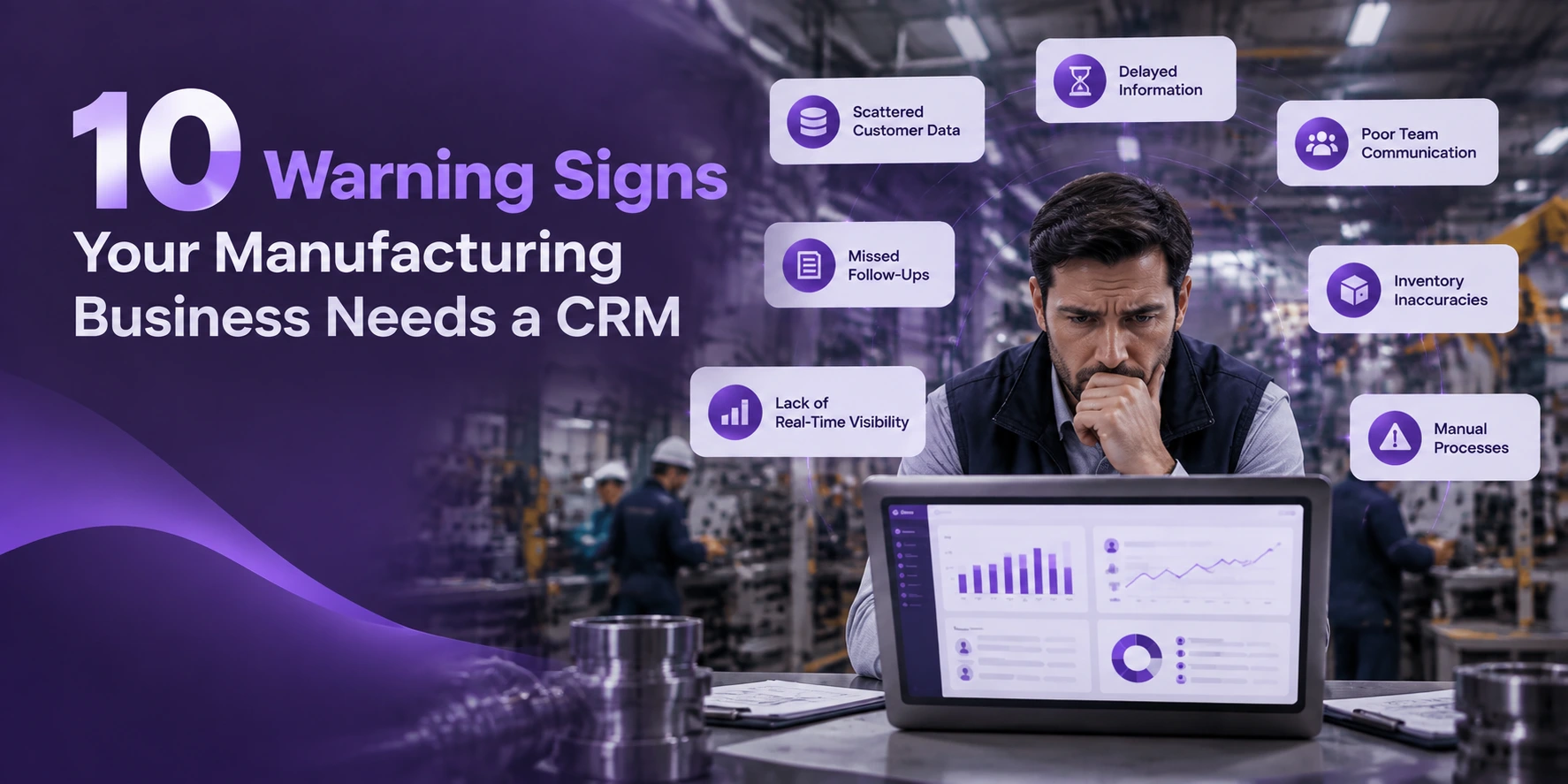
10 Warning Signs Your Manufacturing Business Needs a CRM
1. Customer Data Lives in Spreadsheets, Inboxes and Reps' Heads
Ask three people for a key account's status and you get three answers. The sales rep keeps notes in Outlook, inside sales owns a pricing spreadsheet, and customer service logs complaints in a shared mailbox.
This turns into a crisis when a senior rep retires or joins a competitor. Years of contact history, pricing promises and buyer preferences walk out the door. The next rep starts from zero with an account that expects continuity.
How a CRM fixes it: Every email, call, meeting note, quote and service case attaches to the account record. Email and calendar integration logs activity automatically, so knowledge stays with the company, not the individual.
2. Quotes Take Days and Pricing Errors Keep Slipping Through
In manufacturing, the quote often decides the deal. Yet many teams still build quotes in Excel templates, check stock by phone and email engineering to confirm lead times.
Each handoff adds delay. Reps copy outdated price lists, miss volume breaks or forget customer-specific terms. One wrong margin on a large order can erase the profit on the whole account.
How a CRM fixes it: A CRM with CPQ (configure, price, quote) applies current price books, discount rules and approval workflows automatically. Connected to ERP, it pulls live inventory and lead times, so reps send accurate quotes faster and every revision stays on record.
3. Your Sales Pipeline Is a Guessing Game
When the CEO asks what will close this quarter, the sales manager phones each rep and adds up their gut feelings. Deals sit at "90% likely" for months, and nobody knows which opportunities have stalled or why.
Without defined stages and activity data, you can't coach reps, spot bottlenecks or decide where to send scarce application engineers.
How a CRM fixes it: A CRM moves every opportunity through clear stages, such as qualification, technical evaluation, quote, negotiation and award. Dashboards show pipeline value, deal age, win rates and stalled deals in real time.
4. Sales Forecasts Don't Match Production Planning
Sales wins a large order, and the plant learns about it when the purchase order arrives. Production then scrambles for raw materials, pays for overtime or expedited freight, and still risks the delivery date. The reverse hurts too: you build inventory for demand that never shows up.
This disconnect is widespread. In Salesforce's 2020 Trends in Manufacturing survey of 750 manufacturing decision makers, 82% called dispersed data and 83% called legacy tools moderate or serious barriers to forecast accuracy. More than eight in 10 also flagged siloed sales and operations teams (Intelligent CIO).
How a CRM fixes it: A CRM turns pipeline data and account run-rates into a demand signal. Operations can feed weighted opportunities into sales and operations planning (S&OP), so purchasing and scheduling start before the order lands.
5. Distributors and Dealers Operate in a Black Box
If you sell through channel partners, you probably know what each distributor ordered from you. You may not know who they sold it to, which deals they're chasing or why sales dropped in one territory.
Without that visibility, two partners chase the same end customer, special pricing gets approved twice, and market development funds (MDF) disappear with no measurable return. The same Salesforce survey found manufacturers who felt their systems were future-ready were nearly twice as likely to be satisfied with their channel partners: 44% versus 25%.
How a CRM fixes it: Partner relationship management (PRM) features give distributors a portal for deal registration, lead sharing, price lists and sales reporting. You see channel performance by partner, region and product line.
When Your Best Rep Leaves, Does Your Customer Knowledge Leave Too?
Every account that lives in an inbox or a spreadsheet is one resignation, one missed reorder, or one stalled quote away from going to a competitor. See how many of these warning signs your team is already living with.
Check My CRM Readiness6. Trade Show and Website Leads Go Cold
Events still drive new business in industrial markets. In Adobe's 2026 survey, 82% of manufacturing leaders named in-person events, conferences and trade shows as their most important acquisition channel.
Yet badge scans often sit in a spreadsheet for weeks after the show. Website RFQs land in a general inbox. By the time someone follows up, the buyer has already spoken to a faster competitor.
How a CRM fixes it: A CRM captures leads from event apps, web forms and email, then routes each one to the right rep by territory, product line or industry. Lead scoring, task reminders and automated nurture emails keep every inquiry moving.
7. Customer Service Can't See Order, Warranty or Service History
A customer calls about a failed component. Your service agent checks ERP for the order, asks engineering for the spec, searches email for the warranty terms and phones the field technician about the last visit.
Meanwhile, the sales rep visits the same customer to pitch an upgrade, unaware of the open complaint. Moments like that damage trust faster than the defect itself.
How a CRM fixes it: Service case management links every complaint, return merchandise authorization (RMA), warranty claim and field service visit to the account. Sales and service share one timeline, so nobody walks into a meeting blind.
8. Repeat Customers Drift Away Unnoticed
Many manufacturers earn a large share of revenue from existing accounts that reorder on a regular cycle. When a steady customer cuts volume by a third, it rarely announces the change. It quietly moves part of its spend to another supplier.
Without a system watching order patterns, you spot the drop at the year-end review, long after you could have saved the account.
How a CRM fixes it: A CRM connected to ERP order history flags accounts whose order frequency or volume falls below their normal run-rate. Account managers get an alert to call before the customer leaves, and they can spot cross-sell openings for related product lines.
9. Handoffs Between Sales, Engineering and Operations Break Down
Custom and engineered-to-order products need input from several teams. Sales captures requirements, engineering designs the solution and operations confirms capacity. When those handoffs run on email, details get lost.
A missed tolerance, the wrong material grade or an unconfirmed delivery date can mean scrap, rework or a penalty clause. Each team blames the others because no single record shows who agreed to what.
How a CRM fixes it: A CRM keeps requirements, drawings, revisions, approvals and internal discussion on the opportunity record. Workflow rules route technical reviews to engineering and capacity checks to operations, with a full audit trail.
10. Reporting Takes Days and Still Raises Questions
At month-end, someone exports ERP data, merges it with sales spreadsheets and builds a slide deck. By the time leadership sees it, the numbers are stale and nobody fully trusts them.
Basic questions stay unanswered. Which industries bring the best margins? What is your quote-to-order ratio? Which product lines are growing in each region?
How a CRM fixes it: CRM dashboards update in real time and track the KPIs that matter in manufacturing: win rate, quote-to-order conversion, sales cycle length, customer lifetime value and revenue by segment. Tools such as Power BI or Tableau can combine CRM and ERP data for deeper analysis.
What to Look For in a Manufacturing CRM
Generic CRMs handle contacts and pipelines well. Manufacturers also need features built around complex pricing, channel sales and ERP data. Use this table to match each feature to the warning signs it solves.
| Feature | What it does | Solves signs |
|---|---|---|
| ERP integration | Syncs accounts, orders, pricing, inventory and credit limits in both directions | 2, 4, 8, 10 |
| CPQ | Configures products, applies price rules and generates quotes | 2 |
| Account-based forecasting | Tracks contracted and run-rate volumes by account and product | 4, 8 |
| Partner portal (PRM) | Gives distributors and dealers deal registration, shared leads and reporting | 5 |
| Lead capture and routing | Pulls in event and web leads and assigns them automatically | 6 |
| Service and field service management | Manages cases, RMAs, warranty claims and technician visits | 7 |
| Workflow and document management | Routes approvals and stores drawings and specs on each deal | 9 |
| Mobile access | Lets reps and technicians update records at customer sites | 1, 7 |
| Dashboards and analytics | Tracks pipeline, win rate and margin in real time | 3, 10 |
Match the platform to the ERP you already run and to how you sell. For example, Salesforce Manufacturing Cloud adds sales agreements that combine contracted volumes with order data. Microsoft Dynamics 365 Sales connects to Dynamics 365 Business Central and Supply Chain Management through Microsoft Dataverse.
One Record for Every Account, Quote, and Conversation
Give sales, service, and operations the same real-time view, with quotes that go out accurate and on time, forecasts the plant can plan around, and distributor sales you can finally see. Talk to our experts about a CRM built for how manufacturers sell.
Talk to ExpertConclusion
Manufacturers rarely struggle because of one big failure. They struggle because small gaps add up: a quote that takes days, a distributor deal nobody can see, a forecast the plant can't plan around, a customer who quietly orders less. If several of the 10 warning signs sound familiar, your business has likely outgrown spreadsheets and inboxes.
A manufacturing CRM connected to your ERP gives sales, service and operations one shared record of every account, quote and conversation. Start by naming the warning signs that cost you the most, then choose a platform and a first phase that solve those first.
Frequently Asked Questions

Complexity matters more than size. If several people handle the same accounts, quotes involve custom pricing or you sell through distributors, a CRM makes sense even for a small team. Smaller manufacturers often feel the pain sooner, because one departing rep or one lost account hits harder.
Not fully. Most ERP systems store customer records and sales orders, but they don't track leads, opportunities, quote revisions, sales activities or partner deals. Some ERPs include CRM modules, yet these often lack the pipeline, marketing and service depth of a dedicated CRM. Integrating the two usually works better.
Three factors drive the timeline: ERP integration scope, data cleanup and the number of business units involved. Many manufacturers start with a focused first phase covering accounts, pipeline and quoting, then add service and partner portals.
Record a baseline before go-live, then track the same metrics afterward: quote turnaround time, win rate, forecast accuracy, sales cycle length and account retention. Changes in these numbers show where the CRM pays back.