The Best CRM for Manufacturers in 2026: 10 Platforms Built for Quotes, Dealers, and ERP
Contact Us
Manufacturers sell differently from most B2B companies. One order can involve an engineer, a buyer, a plant manager, and a distributor, and the same customer may reorder a part for years. This guide compares nine CRM platforms for manufacturers, explains how we compared them, and shows how to connect one to your ERP without creating a data mess.
Key Takeaways
What Is Manufacturing CRM Software?
Manufacturing CRM software is a customer relationship management system built for how industrial companies sell: long quote cycles, layered buying groups, channel partners, and recurring orders. Beyond people and deals, it tracks:
Why Is CRM a Structural Requirement for Manufacturers?
CRM holds together three things that spreadsheets and inboxes cannot.
Longer, multi-stakeholder sales cycles.
A new component moves through engineering review, samples, qualification, negotiation, and often a trial run. Each stage adds stakeholders. A CRM maps that committee and keeps the history when a rep leaves, which matters when a cycle runs 9 to 18 months.
Distributor, dealer, and channel complexity.
Many manufacturers sell direct to key accounts and through distributors, dealers, or reps elsewhere. That raises hard questions: who owns the end customer, who registered the deal first, and what commission does the rep earn? A manufacturing CRM answers them with deal registration, territory rules, commission tracking, and partner portals.
Repeat orders, quotes, and contract pricing.
Much manufacturing revenue is run-rate business on contract terms. Quotes go through several revisions with customer-specific pricing, volume breaks, and lead times. A CRM stores every version and flags accounts whose orders slow down.
How We Compared These Platforms
The order below is not a quality ranking. We grouped platforms from most enterprise-scale to most lightweight, then placed the ERP-native option last, because it only fits one type of buyer. We scored each platform on five criteria that matter most to manufacturers:
Manufacturing CRM Comparison Table
| Platform | Best for | ERP connection | Starting price (USD) |
|---|---|---|---|
| Salesforce Manufacturing Cloud | Large, channel-heavy manufacturers | MuleSoft, SAP and Oracle connectors | $275 |
| Microsoft Dynamics 365 Sales | Microsoft and Dynamics ERP users | Native with Business Central and Finance and Supply Chain Management | $65 |
| HubSpot CRM | Marketing-led growth | Apps or middleware | Free for 2 users; Starter from $15 |
| Zoho CRM | Budget-conscious SMBs | Native with Zoho Inventory and Books; others by API | Free for 3 users; $14 |
| Pipedrive | Small teams, simple pipeline | Marketplace apps and API | $14 |
| Freshsales | Phone-heavy inside sales | Marketplace apps; custom API for SAP or Epicor | Free for 3 users; $9 |
| Insightly | Deals that hand off to project teams | AppConnect | $29 |
| Creatio | No-code process workflows | Marketplace and low-code connectors | $40 + $15 Sales module; $10,000 yearly minimum |
| NetSuite CRM | NetSuite ERP customers | Same database as NetSuite ERP | Quote only |
| Odoo CRM | Manufacturers who want CRM, inventory, and production in one open platform | Built-in with Odoo Inventory, Manufacturing, and Accounting; external API on Custom plan | One app free; paid plans from about $24.90 to $31.10 |
10 Best Manufacturing CRM Platforms for 2026
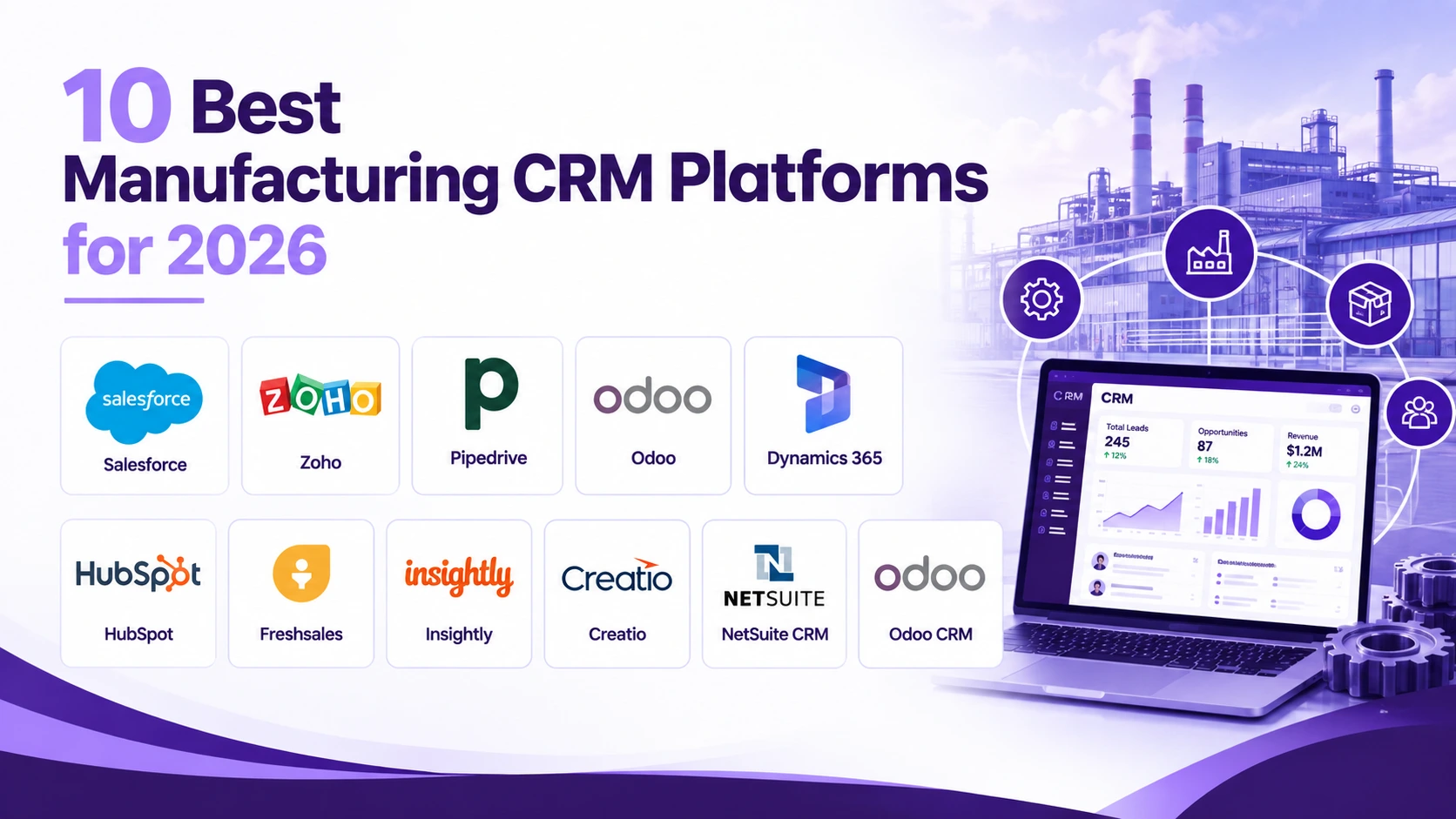
1. Salesforce Manufacturing Cloud
Now sold as Agentforce Manufacturing, it suits large manufacturers with run-rate revenue, big channel networks, and in-house admins.
2. Microsoft Dynamics 365 Sales
Dynamics 365 Sales suits Microsoft 365 users, especially manufacturers on Business Central or Finance and Supply Chain Management, because Microsoft builds the ERP link itself.
3. HubSpot CRM
HubSpot suits manufacturers growing through inbound demand: website enquiries, technical content, and trade show leads.
4. Zoho CRM
Zoho CRM is often a strong fit for a small manufacturing business, with quotes, sales orders, price books, and AI at a low price.
5. Pipedrive
Pipedrive offers a visual pipeline that small teams actually keep updated, with separate pipelines for direct deals, distributors, and RFQs.
6. Freshsales
Freshsales has built-in phone, email, and chat that log every call automatically, which suits phone-heavy inside sales teams.
7. Insightly
Insightly puts CRM and project management in one system, so a won deal becomes an installation or custom-build project without retyping.
8. Creatio
Creatio is a no-code CRM and workflow platform for defined processes such as RFQ intake, engineering review, and pricing approval.
9. NetSuite CRM
NetSuite CRM shares one database with Oracle NetSuite ERP, so reps see live inventory, orders, invoices, and credit while quoting.
10. Odoo CRM
Odoo is a modular business suite, so its CRM sits alongside sales, inventory, manufacturing, purchasing, and accounting apps in one database. That makes it a good fit for small and mid-sized manufacturers who want quotes, stock, and production orders in one place instead of stitching tools together.
Why Manufacturing Companies Need Smarter CRM in 2026
Long quote cycles, dealer conflicts, and ERP data gaps cost manufacturers deals. See how a smarter CRM keeps every account, quote, and order connected.
Read More5 Benefits of CRM for Manufacturing Companies
A Realistic Scenario: Where the Value Shows Up
Picture a 120-person maker of industrial fasteners that sells direct to 40 key accounts and through 15 distributors. Before a CRM, quotes live in spreadsheets, and two distributors have both quoted the same end customer at different prices. After rollout, deal registration flags the overlap before either quote goes out. Order history from the ERP shows one key account has cut reorders for three months, so the account manager calls before the contract renews. Neither result needs advanced AI. Both need the CRM and ERP to share clean data.
How Are AI Agents Changing Manufacturing CRM?
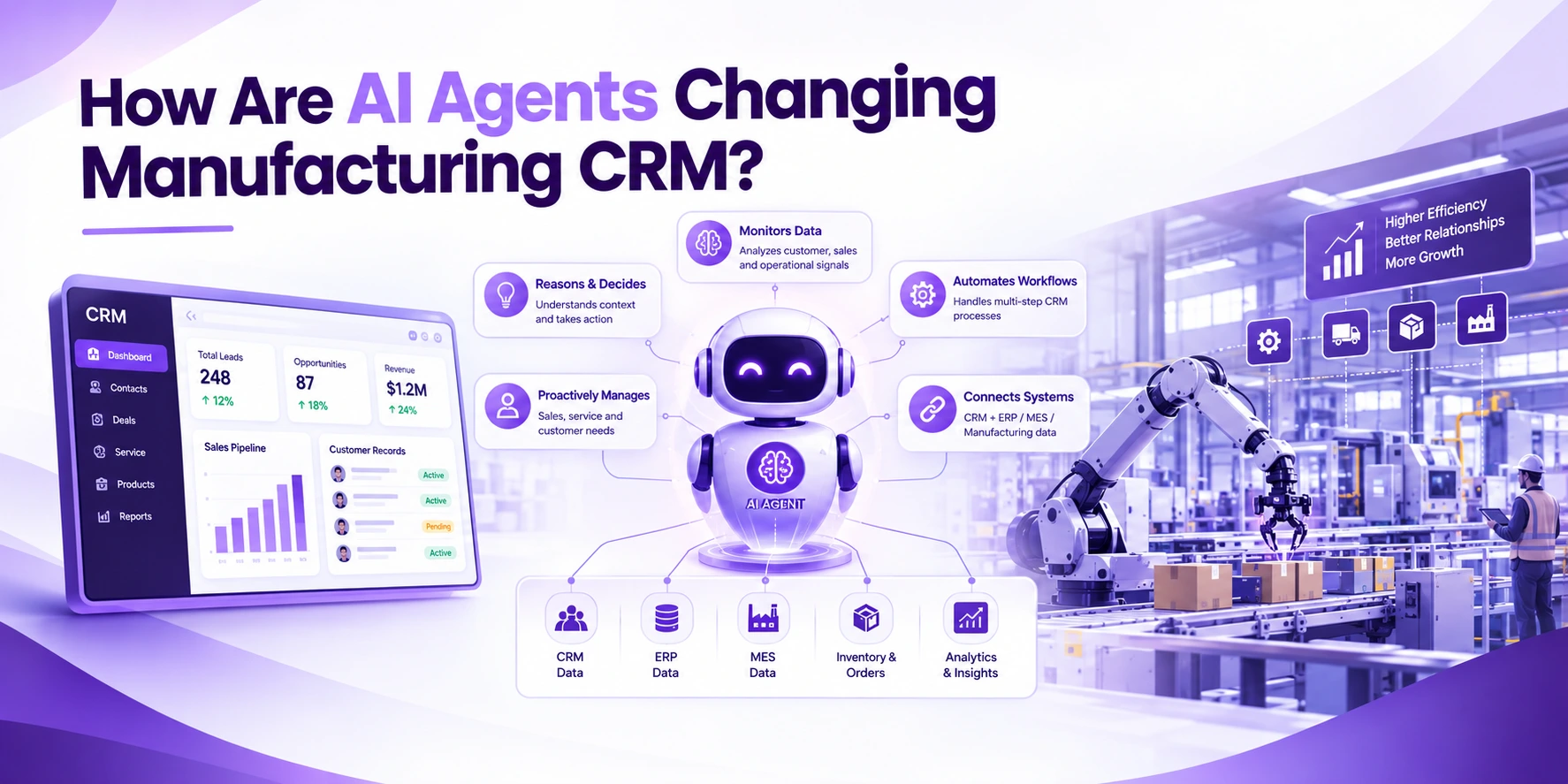
AI agents now handle repetitive work between customer conversations. Salesforce Agentforce, Microsoft Copilot, HubSpot Breeze, Zoho Zia, Freshworks Freddy, and Creatio all push in this direction, and Pipedrive and ZoomInfo offer MCP servers so outside AI assistants can act on CRM data.
What Should a Manufacturing CRM Include?
Use these five areas as a demo checklist.
How To Choose the Right Manufacturing CRM
The right CRM fits how you sell, connects to what you run, and stays affordable after year one.
Start with your sales process
Map one real deal from enquiry to repeat order and mark where handoffs stall. That map shows which features matter.
Check ERP and production integration
List the ERP data reps need, then ask each vendor exactly how their CRM gets it from your SAP, Oracle, Epicor, Infor, Sage, Acumatica, NetSuite, or Dynamics 365 system.
Assess data quality
Audit duplicates and incomplete records before migration. A new CRM will not fix bad data, and AI amplifies it.
Weigh total cost of ownership
Add implementation, migration, integration, training, and AI credits to seat prices, plus fixed costs such as HubSpot's onboarding fees or Creatio's $10,000 minimum, then compare three-year totals. As a simple seat-only example, 25 users on Zoho Enterprise at $40 comes to $12,000 a year before implementation, while 25 users on Salesforce Enterprise at $275 comes to $82,500 a year. Seats are only part of the bill, but the gap shows why the total must be modeled early.
Which CRM Platforms Should Manufacturers Consider?
Start from your situation, not a ranking.
| Your situation | Start your shortlist with |
|---|---|
| Small manufacturing business, mostly direct sales | Pipedrive, Zoho CRM, Freshsales |
| Mid-sized, growing through inbound and distributors | HubSpot CRM, Zoho CRM |
| On Dynamics 365 ERP or Microsoft 365 | Microsoft Dynamics 365 Sales |
| On NetSuite ERP | NetSuite CRM |
| On SAP, Infor, or Epicor | Your ERP vendor's CRM module first, then Salesforce or Dynamics 365 |
| Global group with large channel and rebate programs | Salesforce Agentforce Manufacturing, Dynamics 365 |
| Engineered-to-order with installation projects | Insightly, Dynamics 365 |
| Complex approvals and an enterprise budget | Creatio |
| Manufacturers' rep agency with several principals | Pipedrive, Zoho CRM, or HubSpot set up for commissions |
| Pipeline short on fresh contacts | Add a data provider such as ZoomInfo to your CRM |
| Small or mid-sized manufacturer that wants CRM, inventory, and production in one system | Odoo CRM |
In industrial CRM, the implementation partner and ERP connection shape results as much as the platform does. A well-run rollout of a simpler tool often beats a poorly run rollout of a bigger one.
How Should Manufacturers Integrate CRM and ERP?
Integration works when every piece of data has one owner, one route between systems, and a tested rollout.
Define Which System Owns Which Data
The CRM owns the relationship and everything before the order. The ERP owns products, pricing, stock, and every transaction after it. Document each shared field's owner and sync direction before building.
| Data | System of record | Sync direction | Frequency |
|---|---|---|---|
| Accounts and contacts | CRM | CRM to ERP | On change |
| Opportunities and quotes | CRM | CRM to ERP on win | On change |
| Products and price lists | ERP | ERP to CRM | Daily, or on change |
| Inventory and lead times | ERP | ERP to CRM | Near real time |
| Credit status and holds | ERP | ERP to CRM | Near real time |
| Orders and invoices | ERP | ERP to CRM (read-only) | Overnight is usually fine |
Choose an Integration Method (Native, Middleware, or API)
| Method | Example | Best when | Watch for |
|---|---|---|---|
| Native | NetSuite CRM with NetSuite ERP; Dynamics 365 Sales with Dynamics 365 ERP, Odoo CRM with Odoo Inventory and Manufacturing | One vendor for both | Vendor lock-in |
| Middleware (iPaaS) | MuleSoft, Boomi, Celigo, Azure Logic Apps | Mixed vendors | Subscription fees and mapping upkeep |
| Custom API | Direct code | Legacy or niche ERP | Maintenance and upgrade breakage |
Stock and credit status need near real-time sync. Invoice history can update overnight.
Test, Train, and Roll Out in Phases
Get the Data Right Before You Buy the Software
A manufacturing CRM gives your team structure, but clean data gives it something worth acting on. Merge duplicates, fill in missing roles and direct lines, connect ERP order history, and name one owner for data quality.
Comparing platforms or planning an ERP integration?
Talk to our team, and we'll help you scope requirements, map your data, and plan a rollout that fits how your plant works.
Talk to ExpertPeople Also Ask

A manufacturing CRM handles account hierarchies, channel partners, multi-revision quotes, contract pricing, and repeat orders while connecting with the ERP. A general-purpose CRM can support many of these processes, but often requires more configuration.
Manufacturing CRM systems can connect with ERP platforms through native integrations such as NetSuite and Dynamics 365, middleware such as MuleSoft or Boomi, or custom APIs.
Before implementation, define field ownership and synchronization frequency because these decisions affect data accuracy, workflows, and system performance.
Yes. CRM reporting can identify lapsed reorders, partial-range buyers, inactive accounts, and equipment that may be due for replacement. These insights can help sales teams prioritize existing accounts.
For net-new prospects, manufacturers often combine CRM data with a dedicated B2B data provider.
A simple Pipedrive, Freshsales, or HubSpot implementation can go live within a few weeks. Salesforce or Dynamics 365 implementations that require ERP integration, data migration, custom workflows, and complex configurations typically take several months.
The timeline depends on data quality, integration requirements, user count, customization, and the number of connected systems.
CRM seat pricing is only part of the total cost. Manufacturers should also consider implementation, ERP integration, data migration, training, add-ons, support, and AI credits.
Comparing the total cost over three years can provide a clearer picture than comparing monthly license prices alone.
AI can help manufacturing sales teams with account research, lead scoring, forecasting, recommendations, and follow-up tasks. However, integration and data quality remain critical because AI depends on accurate and complete CRM records.