DMS to CRM Compatibility Matrix: Which CRM Integrates With Which DMS
DMS to CRM compatibility matrix for CDK Drive, Reynolds, Dealertrack, Tekion, and PBS. Learn integration routes, real fees, and red flags before signing.
Contact Us
Dealers pick a CRM on features and discover the integration problem after signing. By then the DMS vendor controls the timeline, the fee, and sometimes the answer.
This matrix reverses that order. It maps every major Dealer Management System to the CRM platforms that can reach its data, explains which integration route each pairing actually uses, and names the fees that land outside your CRM contract.
Read the route column before you read the CRM column. The route decides whether your CRM writes a solid unit back into the DMS or whether your desk manager rekeys it.
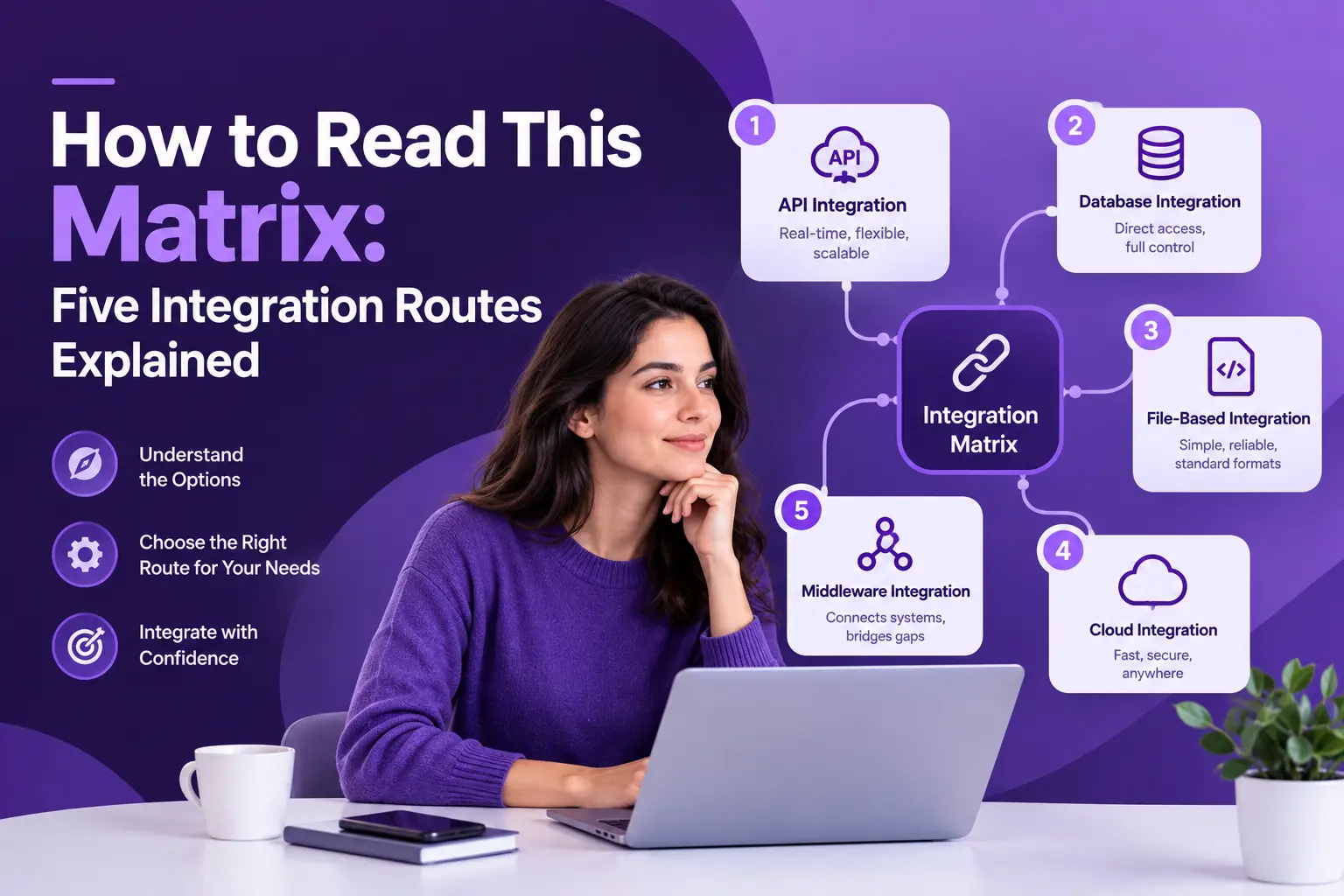
How to Read This Matrix: Five Integration Routes Explained
Every CRM reaches a DMS through one of five routes. Vendors call all five "integration." They are not equivalent.
Route 1: Native, Same Vendor
The CRM and DMS share a codebase and a database. No interface exists because no gap exists. Tekion CRM on Tekion ARC and Elead on CDK Drive operate closest to this model. PBS CRM on PBS DMS does too.
Route 2: Certified Bidirectional API
The DMS vendor runs a certification program, approves the CRM, and permits both reads and writes. CDK runs this through Fortellis. Reynolds runs it through RCI (Reynolds Certified Interface). Dealertrack runs it through Opentrack. Tekion exposes its ARC APIs.
Route 3: Certified Read-Only
Same certification program, reads permitted, writes blocked. Equity mining works because it only needs to read service history and payoff data. Deal writeback fails.
Dealers discover this route late. A vendor says "we integrate with your DMS" and both parties assume bidirectional. Confirm the direction in writing.
Route 4: Third-Party Data Extraction Middleware
Independent companies including Authenticom (DealerVault) and Superior Integrated Solutions sit between the DMS and the CRM, extract data on the dealer's authority, and deliver normalized feeds to whichever vendor the dealer chooses.
This route exists because of how restrictive Route 2 became. It carries its own monthly cost, adds latency, and has been the subject of sustained litigation between extractors and DMS vendors.
Route 5: Flat File, FTP, or Polling
Scheduled CSV or fixed-width exports. The CRM ingests them on a timer.
DMS to CRM Compatibility Matrix
| DMS Platform | Owner | Integration Program | Access Posture | CRM Platforms Commonly Integrated | Typical Route |
|---|---|---|---|---|---|
| CDK Drive | CDK Global | Fortellis | Certified marketplace, fee-based | Elead (native), VinSolutions, DriveCentric, DealerSocket, ProMax, AutoRaptor | Route 1 for Elead, Route 2 for others |
| Reynolds ERA-IGNITE / POWER | Reynolds and Reynolds | RCI | Most restrictive, vendor-side approval | FOCUS (native), Dealertrack CRM, VinSolutions, Elead | Route 1 for FOCUS, Route 2 or 3 for others |
| Dealertrack DMS | Cox Automotive | Opentrack | Open posture, dealer-authorized | VinSolutions (native ecosystem), Dealertrack CRM, DriveCentric, DealerSocket | Route 2 |
| Tekion ARC | Tekion | Tekion APIs | Open, modern REST | Tekion CRM (native), selected third parties | Route 1 for Tekion CRM, Route 2 for others |
| PBS Systems | PBS Systems | PBS API program | Moderately open, Canada-focused | PBS CRM (native), Activix, Dabadu XRM | Route 1 or 2 |
| Autosoft DMS | Autosoft | Autosoft integration program | Moderately open, independent-friendly | DealerSocket, AutoRaptor, Selly Automotive | Route 2 or 5 |
| Solera DMS (formerly Auto/Mate) | Solera | Solera partner program | Moderate | DealerSocket (native), select third parties | Route 1 for DealerSocket |
Read this table as a starting shortlist, not as a contract. Certification status changes with DMS releases, CRM versions, and your specific contract. The verification protocol later in this article tells you exactly how to confirm your pairing.
CRM to DMS Quick Lookup
Already committed to a CRM? Start here instead. Find your CRM in the left column and check which DMS platforms it reaches, and by which route, before you confirm the pairing with both vendors.
| CRM | Owner | Native DMS | Other DMS Platforms Commonly Integrated | Typical Route |
|---|---|---|---|---|
| Elead | CDK Global | CDK Drive | Reynolds ERA-IGNITE / POWER | Route 1 on CDK Drive, Route 2 or 3 on Reynolds |
| VinSolutions | Cox Automotive | Dealertrack DMS (Cox ecosystem) | CDK Drive, Reynolds ERA-IGNITE / POWER | Route 2 on all three |
| DriveCentric | DriveCentric | None | CDK Drive, Dealertrack DMS | Route 2 |
| DealerSocket | Solera | Solera DMS (formerly Auto/Mate) | CDK Drive, Dealertrack DMS, Autosoft DMS | Route 1 on Solera, Route 2 elsewhere |
| ProMax | ProMax | None | CDK Drive | Route 2 |
| AutoRaptor | AutoRaptor | None | CDK Drive, Autosoft DMS | Route 2 or 5 |
| Tekion CRM | Tekion | Tekion ARC | Not designed to run on other DMS platforms | Route 1 |
| FOCUS | Reynolds and Reynolds | Reynolds ERA-IGNITE / POWER | Not designed to run on other DMS platforms | Route 1 |
| PBS CRM | PBS Systems | PBS Systems | Not designed to run on other DMS platforms | Route 1 |
| Activix | Activix | None | PBS Systems | Route 2 |
| Dabadu XRM | Dabadu | None | PBS Systems | Route 2 |
| Selly Automotive | Selly | None | Autosoft DMS | Route 2 or 5 |
| Microsoft Dynamics 365 | Microsoft | None | CDK Drive, Reynolds, Dealertrack, Tekion | Route 2 through a certified partner app, Route 4, or custom build |
| Salesforce | Salesforce | None | CDK Drive, Reynolds, Dealertrack, Tekion | Route 2 through a certified partner app, Route 4, or custom build via MuleSoft |
A CRM with no native DMS carries an integration fee on every pairing, so the fee section below applies to all of them. For a full review of each dealership CRM, see our best automotive CRM software for car dealerships guide.
Where Dynamics 365 and Salesforce Fit
Dynamics 365 and Salesforce are not dealership CRMs. Neither ships with desking, ADF lead parsing, or a certified DMS interface out of the box. OEM importers, distributor networks, and multi-brand dealer groups choose them when they need one customer record above the rooftop CRM, across brands, stores, and non-retail lines of business.
These platforms reach the DMS in one of three ways: through a partner app already certified on Fortellis, RCI, or Opentrack, through extraction middleware such as DealerVault, or through a custom integration built on the DMS vendor's API program. The route decides what the platform can write back, so apply the same verification protocol you would use for any dealership CRM.
Why DMS Data Access Costs More Than Most Dealers Expect
The integration fee is not a technical charge. It is a commercial position, and the industry has litigated that position for a decade.

CDK agreed to pay $100 million plus $250,000 in notice and administration costs to resolve claims that CDK and Reynolds conspired to charge unlawful prices in the markets for DMS services and data integration services. The court approved the settlement on February 25, 2025, covering dealerships that did business with CDK from September 1, 2013 through August 15, 2024. A separate suit brought by software vendor Autoloop, alleging CDK restricted data access and caused vendors hundreds of millions in overcharges, received class action status in July 2024.
That history explains the pricing you encounter today.
CDK
Dealers have reported CDK third-party access charges including application fees, integration fees running $10,000 to $40,000 and up, and recurring monthly charges of $200 and up per rooftop, with vendors passing those costs through on their own invoices. One dealer reported a $30,000 quote simply to integrate accounts payable invoice scanning to CDK accounting data, and moved to Dealertrack instead.
Reynolds
Reynolds carries the most restrictive posture in the category. Third-party tools require RCI to reach data, and those fees reach dealers through vendor invoices. Reynolds has operated the program since 2005 and states publicly that it builds products designed to work together rather than to integrate as an afterthought. Dealer-reported Reynolds DMS pricing runs $1,000 to $5,000 and up per month on three to five year contracts with roughly 4 percent annual escalators.
Dealertrack
Dealertrack positions Opentrack differently. The program permits bidirectional integration between the Dealertrack DMS and certified third-party vendors at nominal annual certification fees, without the per-transaction pricing that defines the other two programs.
The practical consequence: two identical CRM implementations at two identical stores can differ by $500 to $900 per rooftop per month based only on which DMS sits underneath.
New to Automotive CRM?
Learn how dealership CRM captures every lead, automates service reminders, and keeps customer history with your store.
Learn moreWho Authorizes Data Access: The Detail That Decides Control
This distinction matters more than the fee, and almost nobody explains it.
Dealertrack Opentrack Requires Dealer-Level Authorization
An authorized user inside the dealership enables Authorize to Opentrack under Data Extraction User Security, then defines vendor settings per API. No vendor reaches your data until someone at your store grants it, and you revoke access the same way.
Reynolds RCI Operates on Vendor-Side Certification
The vendor completes certification and licensing with Reynolds. The dealer's control over which vendors hold access is correspondingly weaker.
CDK Fortellis Sits in Between
Dealers activate and subscribe to apps through the Fortellis Marketplace, which gives store-level activation and billing, but CDK controls which apps reach certification and at what price.
Before you sign any CRM contract, answer three questions in writing:
A vendor that retains data access after termination is an FTC Safeguards Rule exposure, not just a contract nuisance.
What Each Integration Route Lets Your CRM Actually Do
Route type decides capability. Map your requirements against this before you shortlist.
| Capability | Route 1 Native | Route 2 Certified Bidirectional | Route 3 Read-Only | Route 4 Middleware | Route 5 Flat File |
|---|---|---|---|---|---|
| Read customer and vehicle records | Yes | Yes | Yes | Yes | Yes |
| Read repair order history | Yes | Yes | Yes | Yes | Delayed |
| Equity mining against payoff and service | Yes | Yes | Yes | Yes | Degraded |
| Write sold customer back to DMS | Yes | Yes | No | Sometimes | No |
| Push deal to deal jacket | Yes | Yes | No | No | No |
| Real-time inventory sync | Yes | Yes | Yes | Delayed | Batch only |
| Service appointment writeback | Yes | Yes | No | Rarely | No |
| Survives DMS schema change | Yes | Yes | Yes | Usually | No |
Equity Mining Deserves the Closest Reading
It requires three data sets simultaneously: DMS service history, original deal terms, and current lender payoff position. Route 5 supplies the first two on a delay and rarely supplies the third. If equity mining drives your retention strategy, Route 5 disqualifies the pairing regardless of what the CRM demo showed.
The Full Cost Stack: What Sits Outside Your CRM License
Dealers budget the CRM subscription and miss five other lines. Model all six.
| Cost Line | Who Bills It | Typical Range |
|---|---|---|
| CRM license | CRM vendor | $500 to $3,000 per rooftop per month |
| DMS data access or integration fee | DMS vendor or passed through by CRM vendor | $200 to $800 per rooftop per month |
| One-time integration and certification setup | DMS vendor | $0 to $40,000 depending on platform |
| Historical data extraction | DMS vendor, billed per record or per pull | Quoted per project |
| Third-party middleware, if required | Authenticom, SIS, or similar | $150 to $500 per rooftop per month |
| A2P 10DLC messaging and carrier fees | CRM vendor or messaging provider | $100 to $600 per rooftop per month |
Two lines catch dealers repeatedly.
Historical Data Extraction
Migrating to a new CRM means pulling years of customer and service history out of the DMS. CDK bills history setup API usage separately from ongoing integration under Fortellis pricing. Budget it before you commit to a migration date.
Per-Rooftop Multiplication
A $400 monthly integration fee reads as noise at one store. Across twelve rooftops over a five year contract it reaches $288,000, and nobody put that number in the business case.
Learn more about: Top CRM Software for automotive industry
How to Verify Your Specific DMS and CRM Pairing
Run this protocol before you sign. It takes two weeks and it has prevented more bad implementations than any feature comparison.
Step 1: Get the Route Named in Writing
Send both vendors the same email. Ask: "Is this a native integration, a certified bidirectional API, a certified read-only interface, a third-party extraction feed, or a scheduled file transfer?"
Accept only one of those five answers back. Reject "fully integrated," "seamless," and "works with," because those phrases carry no technical meaning.
Step 2: Name the Program and the Certification Date
Ask which program certifies the connection, Fortellis, RCI, Opentrack, or the DMS vendor's own partner program, and when the CRM last recertified. Certification lapses. A CRM certified against ERA in 2019 may not be certified against your current ERA-IGNITE release.
Step 3: Get the DMS Vendor's Fee in Writing, From the DMS Vendor
Do not accept the CRM vendor's estimate of what the DMS vendor charges. Call your DMS account manager and request the integration fee schedule for that specific CRM at your rooftop count.
Step 4: List the Writeback Fields
Request the actual field list the CRM can write back: sold customer, deal number, VIN, delivery date, salesperson, gross. If the vendor cannot produce the field list, the writeback either does not exist or nobody has tested it.
Step 5: Test With Production Data Volume
Run a sandbox against a real data pull, not a demo dataset. Check duplicate handling against existing DMS customer records matched on phone and VIN, not on name. Name matching produces duplicate records at scale and corrupts your equity mining pool.
Step 6: Write the Exit Terms
Put four provisions in the contract:
The June 2024 CDK ransomware incident, which halted operations at roughly 15,000 dealerships, made the continuity question permanent. Ask both vendors for a documented recovery time objective and the last date they tested it.
Integration Red Flags That Predict a Failed Implementation
Six signals, all of them observable before you sign.
Stuck Between Your CRM and Your DMS?
We integrate Dynamics 365 and Salesforce with CDK, Reynolds, Dealertrack, and Tekion through Fortellis, RCI, and custom middleware. Tell us your setup and we will map the right route.
Talk to ExpertWhich DMS to Choose If You Are Still Deciding
Some dealers arrive here before committing to a DMS. The integration posture should influence that choice directly.
People Also Ask

Elead integrates natively because CDK owns both products, which removes the Fortellis layer and the associated per-rooftop fee.
VinSolutions, DriveCentric, DealerSocket, and ProMax connect through certified Fortellis APIs, and each carries a CDK-billed integration cost on top of the CRM license.
VinSolutions operates on Reynolds platforms through RCI certification, but the depth, direction, and cost vary by contract and by Reynolds release.
Confirm current certification status and the RCI fee directly with your Reynolds account manager before signing, since RCI terms are negotiated rather than published.
Fortellis is CDK's API marketplace and developer platform. Third-party vendors publish certified applications, CDK certifies both the API usage and the marketplace listing, and dealers activate and subscribe at store level.
Fortellis replaced CDK's earlier Partner Program integration model, which used a different fee structure.
RCI is the Reynolds certification program that governs third-party access to Reynolds DMS data. Reynolds has run it since 2005.
Vendors complete certification and licensing on the vendor side, and the associated fees reach dealers through vendor invoicing.
Opentrack is Cox Automotive's web service enabling bidirectional integration between the Dealertrack DMS and certified third-party vendors.
A dealership user authorizes access per vendor and per API inside Data Extraction User Security, which places revocation control at the store rather than at the vendor.
Reported ranges run $200 to $800 per rooftop per month, with CDK and Reynolds at the higher end and Dealertrack at the lower end. One-time integration and certification setup on the more restrictive platforms has been reported between $10,000 and $40,000.
Confirm current figures with the DMS vendor directly, since none of the three publish rate cards.
Yes, through third-party extraction middleware such as Authenticom or through scheduled file transfers. Both routes read data adequately and neither writes deals back reliably. Treat them as a workaround, not a plan.
That depends entirely on your contract language, and most dealers never check. On Opentrack you revoke access yourself.
On RCI and Fortellis you should require automatic termination of access as an explicit contract provision, because retained vendor access after termination creates FTC Safeguards Rule exposure.