Why Manufacturing Companies Need Smarter CRM in 2026
Is your manufacturing CRM ready for 2026? Discover how smarter CRM systems boost sales, improve forecasting, and strengthen customer relationships.
Contact Us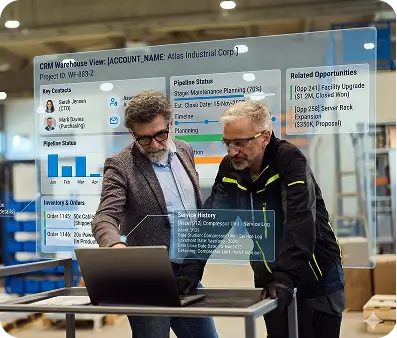
Manufacturing companies lose deals not because of inferior products, but because their customer systems can't keep up. Late quotes, untracked service failures, and silent customer churn are costing manufacturers millions every week.
In 2026, B2B buyers expect faster responses, seamless experiences, and reliable delivery commitments. Manufacturing CRM software unifies sales, production, and service teams around one data source, turning relationships into a measurable competitive advantage.
Key Takeaways
What You Need to Know Before Reading Further
What Is Manufacturing CRM? A Complete Overview
Manufacturing CRM is a software platform that helps manufacturers manage relationships with customers, distributors, and channel partners across the full sales and production lifecycle. It replaces fragmented spreadsheets and disconnected tools with a single, unified system.
Unlike generic CRM tools that track only contacts and deals, a manufacturing CRM connects commercial data to live inventory levels, production schedules, procurement timelines, and material costs, giving every team member the operational context they need to act decisively.
Modern customer relationship management systems also manage the mixed selling environments most industrial companies operate in, direct enterprise accounts, distributor relationships, dealer networks, and digital buyers, all within one platform. When integrated with ERP, it becomes the intelligence layer connecting commercial activity to operational execution.
How Manufacturing CRM Works
Manufacturing sales cycles are long, involve multiple decision-makers, and require customized quoting based on specifications, lead times, and production capacity. Generic CRM platforms aren't built for this; they treat every deal as a simple pipeline stage with no operational context.
A manufacturing CRM bridges this gap through CPQ tools, ERP integration, and partner management. Sales reps quote accurately without waiting on engineering, and delivery commitments reflect real production capacity, eliminating the costly misalignment between what sales promises and what operations can deliver.
How Manufacturers Use CRM Across Sales, Marketing & Service
Sales reps manage pipeline, track quote versions, and automate follow-ups, enabling one rep to handle 50+ accounts efficiently. Marketing teams build targeted campaigns using purchase behavior data, while service teams track warranty claims and dispatch technicians with complete account history before every engagement.
When pipeline data connects directly to production scheduling, manufacturers allocate materials and plan capacity before orders are confirmed, compressing lead times, reducing emergency procurement costs, and consistently outpacing competitors who are still waiting on purchase orders before operations begin.
Why Should Manufacturers Use CRM Software?
Over 86% of manufacturers have adopted CRM because reactive relationship management is directly costly. A single lost enterprise account means millions in revenue. A missed follow-up converts a loyal customer into a competitor reference. Systematic CRM makes the right actions automatic.
In 2026, AI-powered CRM extends this further, predictive churn scoring flags at-risk accounts, autonomous lead qualification prioritizes top opportunities, and real-time production alerts enable proactive communication before customers raise concerns. The gap between CRM leaders and laggards has never been wider.
Top Benefits of Manufacturing CRM
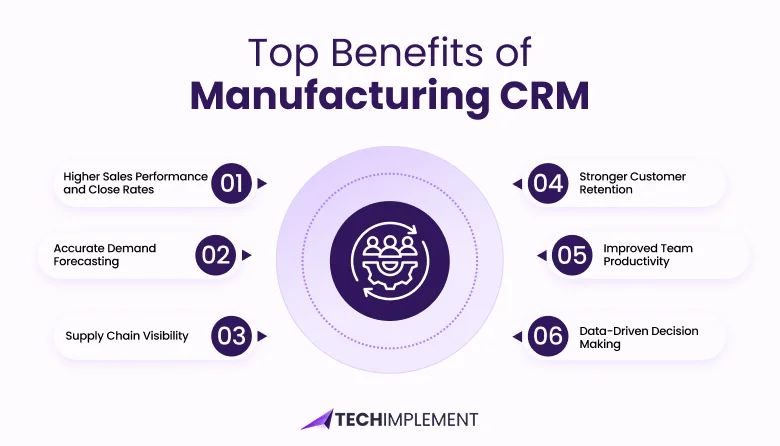
Higher Sales Performance and Close Rates
CRM drives sales around data, not guesswork. Pipeline stages are defined, activities logged automatically, and deal health is visible in real time, helping managers coach reps on evidence and directing sales effort where it creates the most value.
Accurate Demand Forecasting
A well-maintained CRM pipeline is a reliable demand signal. When reps log opportunities with realistic values and close dates, production planners act weeks before orders are confirmed, reducing emergency procurement costs and reactive scheduling.
Supply Chain Visibility
CRM integrated with ERP feeds order probability directly into inventory calculations and supplier scheduling. Manufacturers can set automated procurement triggers based on pipeline thresholds, turning sales data into operational action before competitors receive their purchase orders.
Stronger Customer Retention
A five-year client means reduced acquisition costs, growing revenue, and market credibility. CRM makes retention systematic, with health monitoring flags, disengaging accounts, renewal workflows that trigger automatically, and post-sale follow-ups that prove the relationship matters beyond the transaction.
Improved Team Productivity
Manual overhead logging calls, updating deal stages, sending follow-ups consume hours better spent closing deals. CRM automation handles these tasks completely, shifting routine work from humans to workflows and delivering consistent productivity gains across the sales team.
Data-Driven Decision Making
CRM dashboards provide real-time visibility into win rates, revenue forecasts, and service metrics. In 2026, AI-powered platforms surface insights proactively alerting leadership to emerging opportunities and risks before they appear in standard reporting cycles.
Must-Have Features in a Manufacturing CRM Platform
Manufacturing CRM goes far beyond contact management. These are the essential features every manufacturer needs in 2026:
Sales Pipeline & Lead Management: Full visibility from lead capture to close, with lead scoring that directs sales effort toward the highest-probability opportunities at every stage.
Configure-Price-Quote (CPQ): Enables reps to build accurate, specification-based quotes with customer-specific pricing without involving engineering at every step. Often delivers the fastest ROI in manufacturing CRM.
ERP Integration: The most critical requirement. Real-time ERP integration connects CRM to inventory, production schedules, and delivery timelines, ensuring every customer commitment reflects operational reality.
Order Management: automates the full order lifecycle from creation through shipment and invoicing, giving service teams real-time visibility to manage customer expectations proactively.
AI-Powered Analytics & Forecasting: Predictive lead scoring, demand forecasting, and churn risk detection are baseline expectations in 2026 manufacturers, using them consistently outperform those relying on manual analysis.
Vendor & Partner Management: Centralizes supplier relationships, distributor agreements, and partner performance capabilities that most manufacturers depend on daily, but generic CRM platforms consistently underserve.
Customer Service & Case Management: Tracks warranty claims, routes support tickets, and schedules field technicians with full account history, reducing resolution times and improving product quality through better feedback data.
Security & Compliance: Role-based access, data encryption, audit logging, and GDPR and ISO 27001 compliance are non-negotiable for manufacturers handling sensitive contracts and proprietary specifications.
10 Best Manufacturing CRM Software Solutions for 2026
The manufacturing CRM market in 2026 offers platforms ranging from AI-native enterprise systems to affordable open-source options. The right choice depends on company size, integration requirements, and operational complexity.
| CRM Solution | Key Strengths | Pricing | Best For |
|---|---|---|---|
| Microsoft Dynamics 365 | AI Copilot, full ERP sync, Power Platform | Custom pricing | Mid to Enterprise |
| Salesforce Mfg Cloud | Revenue intelligence, partner portals, Einstein AI | From $300/user/mo | Large Enterprise |
| SAP Sales Cloud | Deep ERP integration, IoT, global compliance | Custom pricing | Global Enterprise |
| HubSpot CRM | Inbound marketing, ease of use, free tier | From $1,575/mo | SMB to Mid-Market |
| NetSuite CRM | ERP-native, order management, SFA | Custom pricing | Enterprise |
| Zoho CRM | Affordable, AI assistant Zia, multichannel | From $14/user/mo | SMB |
| Creatio | No-code workflows, built-in AI agents | From $25/user/mo | Mid to Enterprise |
| Pipedrive | Visual pipeline, simple UI, automation | From $14/user/mo | SMB |
| Infor CRM | ERP-native, supply chain tools, global mfg | Custom pricing | Enterprise |
| Odoo CRM | Open-source, modular, cost-effective | From $13/user/mo | SMB to Mid-Market |
1. Microsoft Dynamics 365: The industry benchmark for enterprise manufacturing CRM. Native integration with Finance, Business Central, and Supply Chain Management, combined with Microsoft Copilot AI, makes it the most unified operational platform for manufacturers. Tech Implement is a Microsoft Authorized Reseller specializing in Dynamics 365 deployments.
2. Salesforce Manufacturing Cloud: Purpose-built for complex B2B relationships and multi-tier distribution networks. Revenue Intelligence applies AI across the full pipeline to surface deal risks, while the AppExchange ecosystem delivers hundreds of manufacturing-specific integrations for deep partner management.
3. SAP Sales Cloud: The natural choice for global manufacturers running SAP ERP. Deep S/4HANA integration, multi-currency support, and IoT connectivity for predictive service make it the most comprehensive option for industrial manufacturers with global operations and strict compliance requirements.
4. HubSpot CRM: The strongest option for SMB and mid-market manufacturers prioritizing inbound marketing and lead generation. Its intuitive interface, free tier, and fast implementation make it the most accessible CRM for manufacturers adopting the technology for the first time.
5. NetSuite CRM: Delivered natively within NetSuite's cloud ERP, making it ideal for manufacturers wanting CRM and ERP in one unified system. Sales, marketing, and service management integrate directly with order management and inventory — eliminating the complexity of separate platforms.
6. Zoho CRM: Exceptional value for mid-market manufacturers. AI assistant Zia delivers intelligent lead scoring and sales predictions at a fraction of enterprise pricing, with a broad integration library adaptable to a wide range of manufacturing workflows.
7. Creatio: A no-code, agentic CRM built for manufacturers who want workflow customization without developer dependency. Built-in AI agents autonomously handle lead qualification, service routing, and supply chain monitoring, reducing manual overhead across sales and operations.
8. Pipedrive: A visually intuitive CRM that helps small manufacturing sales teams manage their pipeline with clarity and discipline. Best suited to manufacturers whose primary need is structured pipeline management rather than deep ERP and production system integration.
9. Infor CRM: is built specifically for global manufacturers and most powerful alongside Infor's CloudSuite Industrial ERP. Offers deep supply chain integration and manufacturing-specific workflows best suited to manufacturers already operating within the broader Infor ecosystem.
10. Odoo CRM: The leading open-source option for cost-conscious manufacturers. Its modular architecture lets manufacturers start with core CRM and progressively add inventory, manufacturing, and financial modules, delivering enterprise-level depth at a fraction of proprietary platform costs.
How to Choose the Right Manufacturing CRM
Start by identifying your core operational pain points: slow quoting, weak forecasting, poor distributor visibility, and high churn, before evaluating platforms. Manufacturers who assess challenges first consistently make better CRM decisions than those who begin with vendor shortlists.
ERP integration depth is the most critical technical factor. Evaluate whether data flows both ways in real time, not just whether an integration exists. This gap determines whether your CRM delivers live operational intelligence or just historical reporting.
Total cost of ownership matters more than licensing price. Build a three-year cost model covering implementation, customization, training, and support. Involve end users in evaluating a CRM that wins on technical specs but fails on adoption, delivers zero ROI regardless of cost.
Future Trends of CRM in Manufacturing (2026 and Beyond)
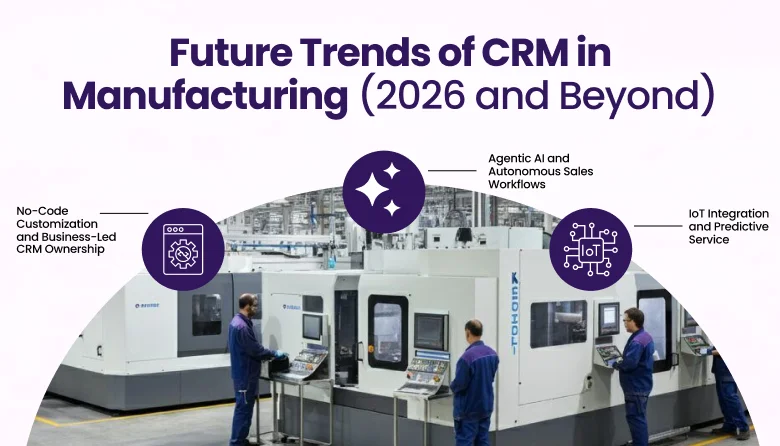
Agentic AI and Autonomous Sales Workflows
AI agents in 2026 can execute multi-step sales processes without human initiation, enriching account records, assigning deals to the right rep, drafting personalized outreach, and scheduling follow-ups within minutes of a buying signal. This compresses response cycles from hours to seconds and eliminates the manual gaps where deals are consistently lost.
IoT Integration and Predictive Service
Connected manufacturing equipment generates real-time diagnostic signals that advanced CRM platforms now use to detect service issues before customers report them. Automated ticket creation, technician dispatch, and parts ordering happen without a customer complaint, shifting manufacturers from reactive service to proactive relationship maintenance.
No-Code Customization and Business-Led CRM Ownership
No-code tools are shifting CRM ownership from IT departments to business users. Operations managers and sales leaders can now configure workflows, build dashboards, and create automation without submitting development requests, accelerating CRM evolution at the speed of business rather than the pace of an IT backlog.
Conclusion
Manufacturing has always been a relationship business. The companies that grow consistently are not those with the lowest prices; they are the ones that understand customers most deeply, respond most reliably, and deliver on commitments most consistently. CRM makes this discipline scalable across every team.
In 2026, the manufacturers pulling ahead are those treating CRM as strategic infrastructure connecting commercial intelligence to operational execution across sales, production, service, and supply chain. The technology now available makes this possible at every company size, from SMB to global enterprise.
At Tech Implement, we have delivered CRM implementations for manufacturers across healthcare, construction, fashion, and financial services for over 15 years. We are a Microsoft Authorized Reseller, ISO 27001 and ISO 9001 certified, with offices across North America, Australia, and Pakistan.
Partner With Tech Implement
FAQs

CRM manages front-office activities sales, marketing, and customer service. ERP manages back-office operations, including finance, procurement, inventory, and production. In manufacturing, both are essential and most powerful when integrated, creating a closed loop between customer demand and operational delivery.
Yes, at higher rates than most industries. Over 86% of manufacturing companies have adopted CRM compared to 73% across all business types. The stakes of poor relationship management in manufacturing are higher, driving broader adoption across company sizes and sectors globally.
Yes. ERP manages operational data but is not designed for sales pipeline management, marketing campaigns, or customer service case tracking. A CRM tells you what will be ordered next and by whom, closing the commercial visibility gap that ERP alone cannot fill.
An SMB deployment can go live in four to eight weeks. An enterprise implementation involving deep ERP integration and custom CPQ workflows typically requires six to twelve months. Tech Implement's phased methodology delivers measurable initial value within eight weeks while building toward full capability across the complete timeline.