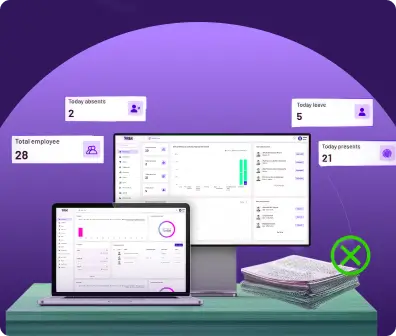
Human resource management is no longer a back-office function. By 2026, it sits at the center of business strategy managing tight labor markets, hybrid workforces, and an AI-driven shift in how work gets done.
Gartner's latest CHRO research, based on more than 400 chief HR officers, places AI-driven HR transformation at the top of the priority list this year. None of that is achievable with spreadsheets and disconnected software.
This is where Enterprise Resource Planning (ERP) systems come in. An ERP platform connects human resource data to finance and operations, so workforce decisions get made with the same rigor as financial ones.
This article breaks down what ERP actually does for HR in 2026, where it creates measurable impact, and where most existing content on this topic stops short.
What an ERP-HR Module Actually Is
An ERP system is a unified software architecture that connects finance, supply chain, procurement, and human resources into a single data environment.
The HR module within that ERP handles the full employee lifecycle: recruitment, onboarding, attendance, payroll, benefits, performance, and compliance reporting.
ERP-HR vs. Standalone HRIS
A standalone HRIS manages employee data well, but it operates in isolation.
An ERP-embedded HR module shares one data layer with finance and operations. A payroll change or new hire automatically updates budgets and cost centers elsewhere in the business, without manual re-entry.
That real-time, cross-functional visibility is the core reason ERP has become foundational to HRM rather than just a convenience.
Core HR Functions ERP Automates
The day-to-day value of ERP in HR comes from centralizing and automating tasks that used to consume most of an HR team's time.
Centralized Employee Data
ERP systems store recruitment records, performance reviews, attendance, and benefits data in a single searchable, access-controlled database. This reduces duplicate records and speeds up audits.
Payroll and Compliance Automation
ERP systems calculate pay using predefined structures for overtime rules, tax withholding, and deductions, and apply them consistently. For multinational organizations, this extends to multi-currency payroll and jurisdiction-specific tax compliance.
Onboarding and Self-Service
New hires can submit documents and track onboarding status online. Once employed, staff use self-service portals to check pay slips and request leave, cutting routine queries reaching HR.
Performance Tracking
Goal-setting and review cycles live in the same system as payroll and headcount data, so performance outcomes connect directly to compensation and succession planning.
Recruitment Integration
Sourcing, screening, and candidate matching feed into the same database used for onboarding, so a candidate's data becomes their employee record automatically once hired.
Benefits Administration
Open enrollment and eligibility tracking sit inside the same platform that manages pay, keeping deductions accurate and removing reconciliation work.
Time, Attendance, and Leave Management
ERP systems track clock-ins, shift schedules, and leave balances against the same employee record used for payroll, so overtime and absence data flow directly into pay calculations instead of being reconciled manually at the end of each cycle. For organizations with shift-based or hourly workforces, this is often where the highest volume of payroll errors used to originate.
Mobile and Manager Self-Service
Most ERP-HR modules now extend self-service to mobile apps, letting employees check schedules or request leave from a phone, while managers approve requests, review team attendance, and access reports without going through HR directly. This shifts routine approvals out of HR's inbox and into the workflow of the people who actually need to make the decision.
By 2026, these functions are table stakes, not a differentiator. Nearly every modern HR platform automates payroll and centralizes records to some degree. The real gap shows up in what's built on top of this layer.
The 2026 Shift: AI and Predictive Analytics in ERP-HR
This is where the conversation has genuinely moved on and where most existing articles on this topic stop short.
Major ERP vendors have spent the past two years embedding generative AI, predictive analytics, and agentic capabilities directly into HR modules. According to SHRM's 2026 State of AI in HR research, 92% of CHROs expect AI to be further integrated into the workforce this year, and 87% anticipate greater AI adoption within HR processes specifically.
Predictive Turnover Modeling
By analyzing tenure, absenteeism, and engagement together, ERP-embedded analytics can flag employees at elevated flight risk before resignation, giving managers time to intervene.
Skills-Gap Forecasting
Predictive models can project which skills will become scarce and where training investment will have the highest return relevant given that roughly three-quarters of employers report difficulty finding the skills they need.
Capacity and Scenario Planning
Modern ERP-HR data layers connect headcount, project demand, and cost data, letting leaders model scenarios entering a new market, restructuring a team before committing to them.
Conversational Employee Service
AI assistants embedded in self-service portals now handle routine queries like leave balances and policy questions directly, reducing repetitive tickets reaching HR teams.
The Governance Caveat
This only works on clean, well-governed data. Roughly half of organizations using AI in HR still lack a formal policy for it, and of those that do, only about a quarter consider it clear and durable. A prediction built on inconsistent data, with no governance framework around it, is just noise with extra confidence attached.
Bias and Fairness Monitoring
Predictive models trained on historical HR data can inherit the biases baked into that history — for example, learning that certain roles or demographics had lower promotion rates and treating that pattern as a benchmark rather than a problem to fix. ERP vendors are increasingly building bias-detection checks into AI-driven HR features, but the responsibility for reviewing and correcting those patterns still sits with the organization, not the software.
The Measurable Business Impact
Time and Cost Savings
Automating payroll, benefits, and onboarding removes redundant manual entry, cutting administrative hours and error-correction work.
Compliance Risk Reduction
Built-in tax rules and audit trails reduce the risk of penalties tied to payroll errors or mishandled records.
Global Regulatory Compliance
For companies operating across multiple countries or states, ERP systems can be configured to apply different labor laws, tax rules, and reporting requirements automatically based on employee location. This matters more each year as jurisdictions introduce their own rules around AI use in employment decisions, making manual compliance tracking increasingly impractical for any organization operating in more than one region.
Faster, Evidence-Based Decisions
Real-time dashboards replace static monthly reports, letting HR and finance work from the same numbers.
Stronger Employee Experience
Self-service access and faster query resolution correlate with higher engagement, since employees spend less time chasing HR for basic answers.
Better-Informed Workforce Investment
Predictive analytics layered on ERP data let organizations connect hiring and training spend directly to outcomes like productivity, rather than tracking activity metrics alone.
Stronger Succession Planning
Because performance, tenure, and skills data already sit in one place, ERP systems make it easier to identify internal candidates for key roles before a vacancy becomes urgent. This reduces the cost and risk of external emergency hiring for leadership or specialist positions where the talent pool is already tight.
These gains don't require chasing the most AI-saturated platform on the market. They require clean data and a system that connects HR to the rest of the business.
Implementation Challenges Most Articles Skip
ERP-HR implementation is often described as a smooth rollout. In practice, three issues derail more projects than vendor selection ever does.
Data Migration Quality
Inconsistent records and undocumented exceptions don't disappear during migration they get automated at scale instead. Cleaning data before migration determines whether the new ERP is actually more accurate than what it replaced.
Change Resistance
Staff who've worked around legacy systems for years often distrust a platform that changes daily workflows. Training that explains the "why," not just the mechanics, drives real adoption.
AI Governance Gaps
Organizations that haven't defined who reviews AI-driven recommendations, or what employees are told about automated decisions, are setting themselves up for trust problems regardless of model accuracy.
Data Security and Privacy
ERP-HR systems hold some of the most sensitive data a company manages salaries, performance reviews, health and benefits information. Centralizing that data improves access control compared to scattered spreadsheets, but it also means a single point of failure if permissions aren't configured correctly. Role-based access, encryption, and regular security audits matter as much as any feature comparison when choosing a system.
A phased rollout starting with payroll, then expanding to performance management and predictive analytics consistently outperforms a full-suite go-live in one move.
Does ERP-HR Scale Down to Smaller Organizations?
The core value one source of truth, automated payroll, fewer reconciliation errors applies regardless of company size. The cost-benefit calculation shifts, though.
A smaller company may get most of the practical benefit from a lighter HRIS. The cross-functional finance integration and predictive planning that justify a full ERP tend to pay off once an organization has multiple departments or entities whose data genuinely needs to stay synchronized in real time.
The deciding factor isn't headcount on its own it's how much manual reconciliation between HR and finance is already happening, and how costly the resulting errors have become.
Choosing the Right Fit
Rather than starting with a vendor shortlist, start with a few internal questions.
- Does the current pain point sit in payroll accuracy, compliance, employee experience, or workforce planning?
- How clean and centralized is the existing employee data, and what will migration realistically take?
- Who will own data governance once predictive features are switched on?
- Does the organization need deep finance integration, or is a standalone HRIS sufficient?
Organizations that answer these honestly before evaluating software tend to implement faster and see returns sooner.
Measuring ROI After Go-Live
The most reliable way to track ERP-HR return on investment is to set baseline numbers before implementation time spent on payroll processing, average onboarding duration, error rates in compliance reporting and measure the same metrics six and twelve months after go-live. Without that baseline, it's difficult to separate genuine efficiency gains from the natural improvement that comes simply from staff getting used to a new system.
Conclusion
ERP systems have earned their place at the center of modern human resource management because they connect HR data to the rest of the business in real time, not because they digitize paperwork.
The administrative gains centralized records, automated payroll, self-service remain the foundation. The real competitive edge in 2026 comes from what sits on top: predictive analytics and AI-assisted decisions, built on data clean and governed enough to trust.
Organizations that treat ERP-HR as a strategic data platform, rather than a digitized filing cabinet, are the ones turning workforce management into a genuine business advantage.
As labor markets stay tight and AI continues reshaping how work gets distributed across teams, the organizations that invested early in clean, well-governed ERP-HR data will be the ones making faster, better-informed workforce decisions — not because the software made the decisions for them, but because it gave them the visibility to make better ones themselves.