Prescriptive Analytics: Real Use Cases That Drive Results
Discover how prescriptive analytics helps businesses make smarter decisions, boost efficiency, and achieve measurable results through real-world use cases.
Contact Us
Data is everywhere, but turning it into meaningful actions is where most businesses fall short.
While descriptive and predictive analytics explain what happened and what might happen next, prescriptive analytics answers the most important question: “What should we do about it?”
It is the final and most actionable stage of business analytics. It turns data into guided actions that directly increase performance and profits. In this article, we’ll discuss what it means, how it works, and how real prescriptive analytics use cases to achieve measurable results.
What is prescriptive analytics?
Prescriptive analytics is an advanced types of data and business analytics that goes beyond predicting outcomes; it recommends the best actions to achieve them. By using data modeling, simulation, optimization, and machine learning, it analyzes various scenarios to find the most effective approach. Unlike predictive analytics, which shows what might happen, prescriptive analytics guides decision-makers on what to do next. Its goal is to help organizations make smarter, data-driven choices that don’t just anticipate the future but actively shape it.
How Prescriptive Analytics Works
These analytical models combine data science, artificial intelligence, and your operational and business data into a single process. The process typically involves:
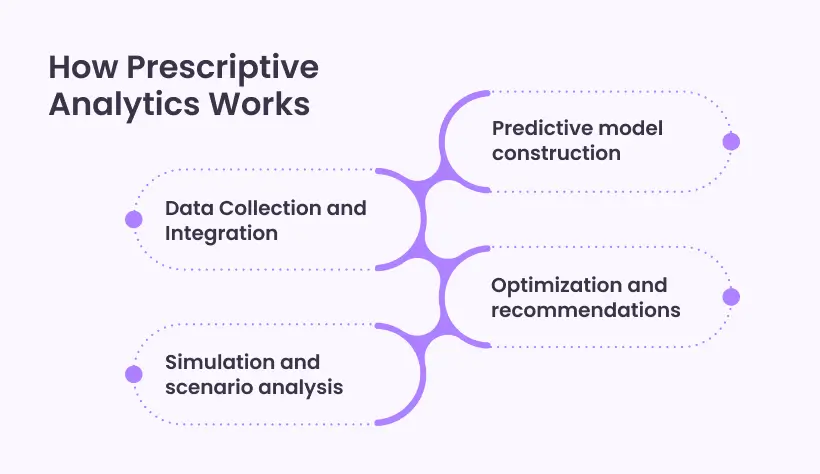
Data Collection and Integration
The data collected comes from various sources, including MS D365 CRM, ERP, operations, marketing, and external sources, which are all consolidated into an aggregated and trustworthy view of the business performance.
Predictive model construction
The machine learning models analyze data to predict trends, risks, and opportunities, which provide a foundation for the next step.
Simulation and scenario analysis
A series of what-if simulations provides a level of awareness about the potential implementation of a strategy in various scenarios.
Optimization and recommendations
Finally, optimization algorithms evaluate all possible options and recommend the most effective and efficient course of action or intervention.
Business Analytics: Real-world Use Cases
Let’s look at how businesses in different industries use prescriptive analytics to solve real challenges.
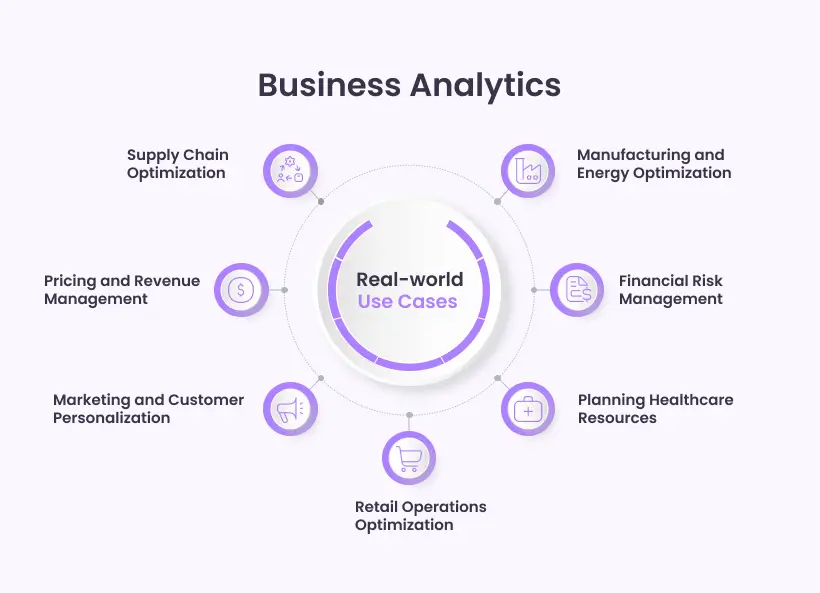
Supply Chain Optimization
In a world of volatility, supply chain agility is paramount. Intelligent data insights can help organizations predict inventory volumes, optimize logistics routes, and assess supplier reliability, resulting in increased operational efficiency while reducing costs.
For example, a logistics company utilized AI-based route simulations to evaluate the least expensive way to deliver products, resulting in a 25% reduction in transportation costs and an 18% improvement in delivery time consistency. The outcome? Improved resource allocation and a happier customer.
Pricing and Revenue Management
Taking pricing to a level beyond "guessing" can be assisted by prescriptive analytics. This type of analytics assesses historic trends, competitor pricing, and customer demand to offer real-time dynamic pricing recommendations. This ultimately helps organizations achieve profitability goals without sacrificing competitiveness.
For example, the airline industry and many e-commerce retailers rely on real-time analytics to adjust pricing based on seasonality, spikes in demand, and consumer behavior, ultimately resulting in revenue increases of between 10% and 15% while simultaneously retaining customers by utilizing a value-based pricing strategy.
Marketing and Customer Personalization
Marketing success depends on delivering the correct message to the right place at the right time. It allows brands to identify the best customers to target, when to reach them, and what message will resonate the most. Further enhancing the timeliness of the engagement, brands can utilize behavioral data along with prescriptive, powerful analytics to create hyper-personalized campaigns, which means they are relevant to each specific individual customer.
For example, a telecommunications company used intelligent data insights models along with its own to find out which customers were likely to go and what the best deal was for each one based on the churn model. The result was a 20% reduction in churn and a 15% increase in customer lifetime value, confirming that the precision behind personalization drives value for both the business and customers and return on investment.
Retail Operations Optimization
Many retailers face the perennial problem of inventory management and try to satisfy the customers' demands. Prescriptive analytics solve this problem by anticipating customer buying behaviors, automating reorders, and optimizing shelf space for products. This procedure ensures that the correct product is at the right store at the right time for customers to purchase.
An example of this is a retailer taking analytical approaches after hindsight to capture the best demand estimates for seasonal products, achieving 98% in stock accuracy for that selling season while driving down waste. The better demand estimates allowed the retailer to consistently drive sales while improving the quality of the customer experience.
Planning Healthcare Resources
In healthcare, a plan for time and resources can directly affect a health outcome. These analytics help hospitals create staffing schedules, manage patient flow, and allocate assets based on real-time demand.
For Instance, a hospital network engaged prescriptive scheduling models to maximize operating room utilization and assign staff, which resulted in a 22% reduction in patient wait time, along with a 17% increase in bed utilization without adding staff.
Financial Risk Management
Financial firms view AI-driven analytics as a reliable avenue for managing uncertainty. It helps uncover insights related to risk, portfolio management, and automated compliance assessments. As firms continue monitoring in real time, these advanced data models would indicate data-driven lending and investing decision-making.
For example, a major bank implemented real-time prescriptive analytics for its fraud detection, resulting in a 30% decline in false positives and speedier detections of fraudulent activity. Overall, this boosted customer trust and the bank's bottom line.
Manufacturing and Energy Optimization
Manufacturers utilize Intelligent data insights to create smarter and more sustainable operations. Predicting machine failure, optimizing maintenance schedules, and reducing wasted energy translate into increased uptime and operational efficiency.
For example, a manufacturing firm implemented prescriptive models into its machinery monitoring systems, which resulted in reduced unplanned downtime by 40% and reduced energy costs by 15%. This shift to proactively maintaining machinery allowed the firm to respond to costs in a more business-as-usual manner.
Benefits of Prescriptive Analytics
When businesses use advanced analytics tools, they get big benefits in their operations and strategies.
By turning data into clear, actionable insights, businesses move from being reactive to truly data-driven and forward-looking.
Tools and Technologies for Prescriptive Analytics
Prescriptive analytics is powered by a growing ecosystem of intelligent tools and cloud-based platforms. It leverages AI, machine learning, cloud computing, and big data processing to turn complex datasets into actionable recommendations. Some of the most widely used tools that enable these capabilities include:
Tech Implement: We help businesses connect their data, automate analysis, and drive decisions that lead to measurable impact.
Emerging Trend: Agentic Analytics and Autonomous Decision Systems
The evolution of analytics is moving toward agentic analytics systems that don’t just recommend actions but can automate and execute them using AI-driven agents.
This next step builds upon prescriptive analytics by combining decision intelligence with autonomous execution. Imagine a system that not only suggests how to optimize ad spend or inventory levels but actually makes those adjustments in real time.
Example: An AI-powered marketing platform autonomously reallocates ad budgets to the best-performing channels, improving ROI without human intervention.
Why Agentic Analytics Is Gaining Momentum, Backed by Data:
The global Agentic AI market is projected to grow from USD 4.35 billion in 2025 to USD 103.28 billion by 2034, with a 42.2% CAGR.
Another forecast predicts the autonomous AI agents' market will reach USD 126.2 billion by 2032, growing at 43.8% annually.
Among enterprises using AI agents:
73% of executives believe AI agents will provide a competitive advantage within the next year.
At Tech Implement, we help organizations prepare for this next generation of analytics where AI doesn’t just inform decisions; it makes them.
How Tech Implement Helps Businesses with Prescriptive Analytics
At Tech Implement, we bridge the gap between analytics strategy and execution. Our team combines expertise in AI, automation, and business intelligence to design prescriptive analytics solutions that deliver real outcomes, not just dashboards.
Whether it’s automating marketing actions, optimizing operations, or reducing risk exposure, our goal is simple: help businesses make better decisions and faster.
Transform your analytics strategy. Partner with Tech Implement today.
FAQs

Prescriptive analytics goes a step beyond predictive analytics. While predictive analytics forecasts what is likely to happen, prescriptive analytics recommends the best actions to take based on those predictions to achieve desired outcomes.
Industries like retail, manufacturing, healthcare, finance, logistics, and marketing see the greatest transformation through prescriptive insights.
By guiding businesses toward cost-effective, high-impact decisions and reducing uncertainty, it enhances profitability and growth.
Absolutely. With scalable, cloud-based tools like Dynamics 365 and Power BI, small businesses can access enterprise-grade analytics without heavy infrastructure costs.