How to Build a Data-Driven Culture in Your Company
Build a data-driven culture that turns insights into action. Empower teams, improve decisions, and drive business growth with smarter data strategies.
Contact Us
In today’s digital landscape, organizations are collecting more data than ever, yet many remain insight-starved. Studies show that while approximately 73% of businesses have adopted some form of data-driven culture and organizational decision-making, only about one-third of companies claim that their decisions are fully based on data rather than intuition.
Companies that truly embrace a data-driven culture report up to an 8% increase in profit and a 10% reduction in costs. The challenge, therefore, is not in the volume of data, but in aligning people, processes and technology so that this data is turned into timely, fact-based decisions. The data-driven organizations that succeed in doing so become agile, transparent, and consistent industry leaders.
This guide will show you how to create that kind of culture, why it's important, and the difficulties that come with it. It will also give you a step-by-step plan for success and talk about the significance of leadership, the part that various technologies play in making the change easier, and how business analytics tools can measure success.
What Is a Data-Driven Culture?
Definition & characteristics
It's called a "data-driven culture" (or "data-first" or "analytics-driven organization") when choices are made based on good data and analysis instead of gut feelings, hierarchy, or past decisions.
In a mature, analytics-driven business, three principles define success:
These core principles, accessibility, accountability and actionability, distinguish organisations that just “have data” from those that truly “are data-driven”
Building data maturity means shifting from guesswork to evidence-based decision-making, where every move is backed by insight, not assumption.
Data-driven vs. legacy decision-making
| Legacy (Intuition-based) | Data-Driven Culture |
|---|---|
| “We always do it this way.” | “What do the numbers tell us?” |
| Decisions based on seniority | Decisions based on evidence |
| Departments act in silos | Cross-functional data sharing |
| Tools and data are marginal | Analytics is embedded in workflows |
When a company embraces the meaning of a data-driven culture, analytical thinking moves from a pilot project to the operating model.
Why Building a Data-Driven Culture Is Essential
Create urgency & show the value
Research shows that organisations that embed data and analytics outperform those that don’t, proving the importance of a data-driven culture.
These stats highlight both the opportunity and the risk: the upside from being data-driven is big, but many companies struggle to realise it.
Key benefits
Real-world example
A retail or manufacturing business used analytics to optimize its supply chain, forecast demand more accurately and reduce waste, which translated into higher ROI and improved customer delivery, clear evidence of the importance of a data-driven culture and measurable business intelligence ROI. McKinsey & Company+1
Common Challenges in Creating a Data-Driven Culture
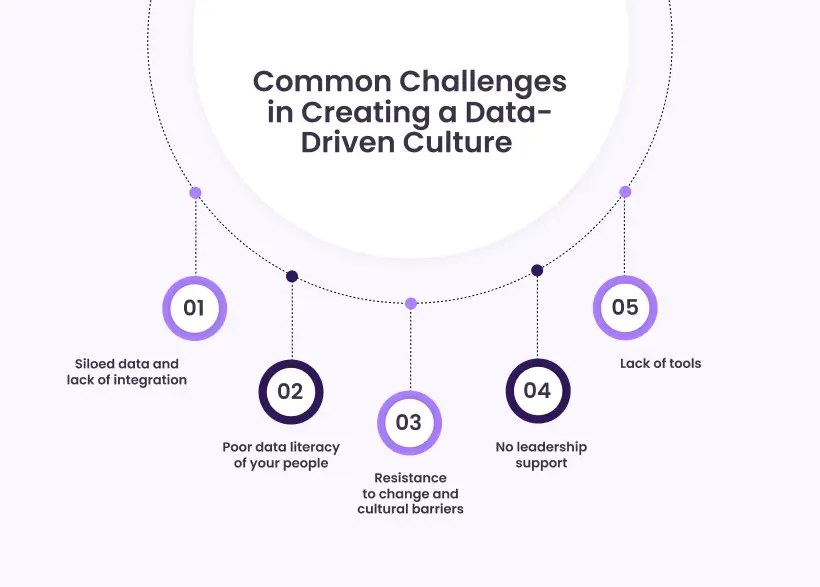
Below are typical pain points many organisations face when attempting this transformation:
Siloed data and lack of integration: Data exists in silo ‘systems’ (finance, sales, operations) that are not available to the entire enterprise, creating major data silos that hinder collaboration.
Poor data literacy of your people: Even if the data exists, people may not understand it or know what to do with it. These Data literacy challenges, according to one source, are the foundational pieces for culture change. Hyperight+1
Resistance to change and cultural barriers: Employees or leaders may try to default to "this is how we have always done it" rather than embrace the evidence-based method.
No leadership support: Without your executive leadership's commitment (actual funding, identification of resources and role modelling) to the initiative, it will fall flat.
Lack of tools: Legacy systems, governance issues, or the absence of a robust analytics platform can derail progress, further amplifying analytics adoption barriers.
Understanding these barriers early helps you anticipate and mitigate them.
Step-by-Step Guide: How to Build a Data-Driven Culture
Here is a practical roadmap you can follow to how to build your data-driven culture, aligned with your organisational goals.
1. Get Executive Buy-In
Executive support is crucial, as they create the environment, allocate funds and set an example of the behaviours needed in the organisation. For example, C-level support can accelerate engagement quicker and higher.
2. Define Clear Data Goals and Metrics
Tie analytics programmes to business outcomes: e.g., increase customer satisfaction score by 15 %, reduce time to decision by 30 %, improve forecast accuracy by 20 %. Clear goals help connect analytics with value.
3. Invest in Data Literacy and Training
Equip your teams with the skills to interpret data, ask the right questions and use analytics tools. Examples: data workshops, internal analytics bootcamps, peer mentoring.
4. Build a Unified Data Infrastructure
Integrate systems so data flows between CRM, ERP, operations and marketing (for example: Microsoft Dynamics 365 + Power BI). Ensure secure centralised data storage, strong governance, and business data integration self-service access.
5. Promote Cross-Department Collaboration
Break down silos: encourage joint data projects between marketing, sales, operations, finance and IT. Shared dashboards, cross-functional analytics teams and common KPIs help.
6. Implement the Right Analytics Tools
Select analytics tools that empower people, not just technologists. Consider modern BI tools like Power BI, Tableau, or cloud analytics platforms that support fast insight generation and visualisation.
7. Encourage Data-Driven Decision-Making
Embed KPI dashboards, regular data-review rituals, decision forums where analytics is presented, challenged and acted upon. Make data-review part of your rhythm.
8. Measure, Iterate, and Improve
Track your cultural metrics (adoption rate, decision turnaround time, ROI), learn what works, refine the process and scale. Building a data-driven culture is continuous, not a one-off project.
These steps to a data-driven company when followed in sequence and reinforced by leadership and infrastructure, create sustained change and competitive advantage. Keywords to keep front of mind: how to build a data-driven culture, steps to a data-driven company, analytics tools, business data integration.
Technologies That Support a Data-Driven Culture
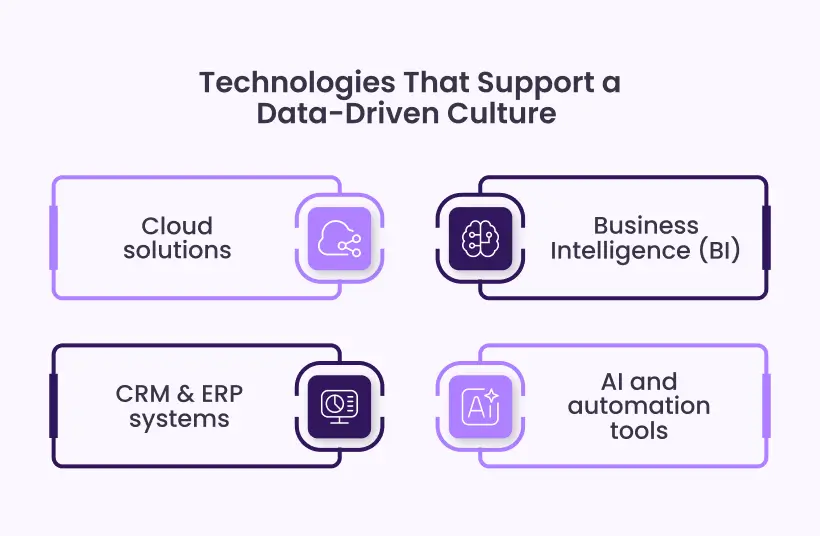
Here’s how technology plays a commercial role in enabling your transformation:
These technologies form the backbone of a data-driven culture, but remember: tech alone doesn’t create culture. That comes from people + process + leadership + tools
The Role of Leadership in Driving Change
Culture always starts at the top. For your organisation to become data-driven, leadership must:
Measuring the Success of a Data-Driven Culture
How will you know you’re making progress? Here are key metrics and a mindset for continuous measurement:
Key Metrics
Continuous improvement
Building a data-driven culture is a journey. Use these analytics success metrics and data culture KPIs to conduct regular retrospectives: what’s working, what’s not, and where to invest next. Iterate on the strategy, refine your infrastructure, and evolve your processes to increase digital maturity over time.
How Tech Implement Helps You Build a Data-Driven Organization
Tech Implement helps businesses turn their analytics ambition into an operational reality through end-to-end data-driven transformation. Here’s how we help:
FAQs

You’ll see leaders asking for dashboards, teams referencing analytics in meetings, increased self-service tool usage, cross-department data sharing and decisions backed by evidence rather than opinion.
Begin by defining one or two key metrics tied to business outcomes, deploy a lightweight BI tool, train a pilot group, and iterate. Use incremental wins to build momentum and expand.
Culture is the glue that makes technology and process work. If the organisation resists data usage, sticks with intuition, or fails to embed accountability, even the best tools won’t deliver outcomes. Leadership modeling, reward systems and openness matter.
Yes, AI can power predictive analytics, automate routine decisions and surface insights at scale. But without the underlying culture, governance, data literacy and alignment to business goals, AI won’t realise its potential.