How Hotels Use Smart Technology to Run Better and Earn More
Contact Us
What Is a Smart Hotel Property Management System?
A Property Management System (PMS) is the software that controls a hotel's core operations reservations, check-in and checkout, room assignments, billing, and reporting. In its earliest form, it replaced the paper register with a basic digital record.
A smart PMS is fundamentally different. Built on cloud infrastructure with open APIs and embedded AI, it connects every hotel department into one live platform turning operational data into decisions rather than simply storing it for end-of-day review.
Traditional PMS vs. Smart PMS
A traditional PMS records what happened. A smart PMS influences what happens next. The difference lies in three capabilities that define every modern platform worth evaluating.
Cloud Infrastructure: All data is hosted securely off-site, accessible from any device, updated automatically with no server hardware for hotel staff to manage or maintain.
Open API Architecture: The PMS connects to specialist tools, revenue management engines, payment gateways, and CRM platforms through published APIs, making it the hub of a broader ecosystem.
AI and Automation: Machine learning automates pricing decisions, housekeeping scheduling, and guest communication reducing manual workload while improving the accuracy of every operational output.
Core Modules of a Smart Hotel PMS
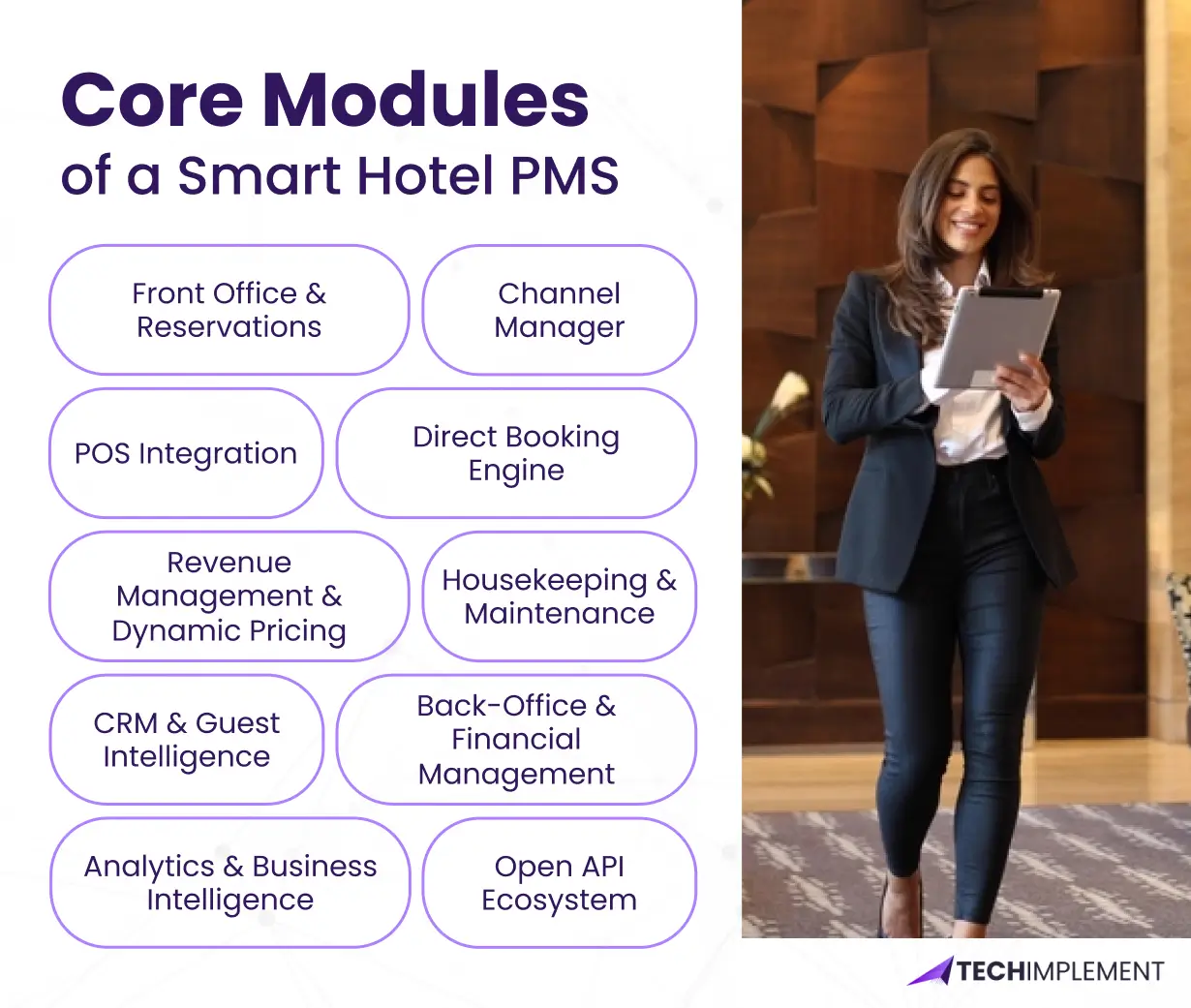
A smart PMS is a connected suite of functional modules, each managing a distinct area of operations. The system's power comes from how seamlessly these modules share live data with one another across every department.
Front Office & Reservations
The front office module manages the full guest lifecycle from pre-arrival through checkout. Staff access a live dashboard showing room status, arrivals, departures, VIP flags, and outstanding tasks. Any reservation change updates instantly across all connected systems without manual intervention.
Direct Booking Engine
Every OTA booking costs a hotel between 15 and 25 percent in commission. A direct booking engine embedded in the hotel website eliminates that cost while supporting upselling, presenting upgrade and add-on offers before the guest completes the reservation.
Channel Manager
A channel manager synchronizes the hotel's rates and availability across every distribution platform simultaneously OTAs, GDS networks, metasearch engines, and the hotel's own site. One rate update in the PMS propagates instantly to all channels, eliminating double bookings by design.
Revenue Management & Dynamic Pricing
An integrated Revenue Management System (RMS) automates pricing decisions using continuous analysis of booking pace, competitor rates, local events, cancellation trends, and seasonality. AI-powered dynamic pricing adjusts rates in real time increasing Average Daily Rate by 10 to 15 percent on average.
Hotels using AI-driven revenue management report up to 17 percent higher total revenue compared to legacy rule-based systems. The RMS tracks three core KPIs continuously: occupancy rate, RevPAR (Revenue Per Available Room), and ALOS (Average Length of Stay).
Housekeeping & Maintenance
When a guest checks out, the room status updates automatically on every housekeeper's mobile device. Task assignments are distributed by workload and priority. Maintenance faults are logged and routed to engineering digitally eliminating phone-based coordination and reducing room turnaround time significantly.
POS Integration
Hotels generate revenue across restaurants, spas, gyms, and in-room services. POS integration posts every outlet charge directly to the guest folio in real time removing manual transfer errors and providing a complete picture of each guest's total spending.
CRM & Guest Intelligence
A smart PMS CRM builds persistent guest profiles across every stay capturing room preferences, dietary needs, spending patterns, and loyalty status. These profiles travel across multiple visits and, in group environments, across different properties, enabling personalized service at every touchpoint.
Returning guests can be automatically assigned their preferred room type, greeted with preferred amenities, and contacted with personalized pre-arrival communication, all triggered by profile data without manual staff preparation. This precision builds loyalty that repeat-acquisition spending cannot buy.
Back-Office & Financial Management
The back-office module manages the general ledger, accounts payable and receivable, bank reconciliation, tax compliance, and procurement all integrated with front-desk and POS data. Audit-ready financial reports are generated automatically, eliminating the manual spreadsheet consolidation that costs finance teams hours daily.
Analytics & Business Intelligence
Smart PMS dashboards deliver live KPIs to each management role, occupancy curves, channel revenue splits, labor cost ratios, and guest satisfaction trends. Automated nightly reports replace the manual audit. Managers spend less time assembling data and more time acting on it.
Open API Ecosystem
No single vendor builds the best solution for every hotel function. Open APIs allow the PMS to connect with specialist tools dedicated revenue systems, loyalty platforms, workforce scheduling software creating a best-in-class technology stack rather than a one-size-fits-all compromise.
Cloud-Based vs. On-Premise PMS
The deployment model is as important as the feature set. Cloud and on-premise systems carry fundamentally different implications for cost, flexibility, and long-term scalability. The comparison below addresses the criteria that matter most for an informed decision.
| Criteria | On-Premise PMS | Cloud-Based PMS |
|---|---|---|
| Capital Cost | High upfront hardware and licensing fees | Low; monthly or annual subscription |
| Software Updates | Manual; requires scheduled downtime | Automatic; zero operational disruption |
| IT Maintenance | Managed by hotel IT staff | Fully managed by the vendor |
| Scalability | Hardware-bound; expansion is costly | Instant; no infrastructure changes |
| Mobile Access | Limited to on-site terminals | Full access from any device, anywhere |
| System Resilience | Single point of failure if the server fails | Redundant cloud servers; auto-failover |
| Integrations | Complex; often requires custom middleware | Plug-and-play via open APIs |
| Best Suited For | Large legacy operations | All modern property types |
For any hotel evaluating a new PMS today, cloud-based deployment is the rational default. It costs less to maintain, deploys faster, scales without infrastructure investment, and integrates far more easily with the modern hospitality technology ecosystem than any on-premise alternative.
How to Choose the Right Smart PMS
The PMS market spans enterprise platforms built for global chains, all-in-one systems for independent hotels, and lightweight tools for small properties. Selecting the wrong category or the wrong vendor within the right category is a costly, multi-year mistake.
Step 1: Build Your Property Profile First
Before reviewing any platform, document your non-negotiables: number of rooms, number of locations, revenue outlets, OTA channels, corporate vs. leisure mix, and systems currently in use. Every platform you assess must be measured against this profile, not its own marketing.
Step 2: Separate Essential Features from Optional Enhancements
Identify what must work from day one reservations, front desk, billing, housekeeping, basic reporting. Then list valuable-but-secondary modules: advanced CRM, loyalty management, AI upselling. This hierarchy prevents over-specifying and paying for complexity your operation is not yet ready to use.
Step 3: Audit Every Integration Requirement
Every system your hotel currently uses payment terminals, accounting software, access control, and loyalty programs must either integrate with the new PMS or be replaced by it. Verify each integration is certified, not theoretical. Request references from properties using the same integration stack.
Step 4: Calculate Total Cost of Ownership
Monthly subscription fees are the most visible cost but rarely the largest. Quantify implementation fees, data migration, integration development, training, and ongoing support. Then model the financial return: projected ADR improvement, labor hours saved, and OTA commission reduction through increased direct bookings.
Step 5: Test Usability with Your Actual Team
Request a live demonstration using real scenarios from your daily operations a group check-in, a billing dispute, a housekeeping block, a rate override. Involve the front-line staff who will use the system daily. Their assessment of usability is the most operationally relevant input.
Step 6: Validate Support Infrastructure
Verify the specific support model before signing: is 24/7 support included or priced separately? What is the guaranteed response time for critical failures? Is a dedicated implementation manager assigned to your go-live? Call references at similar properties that recently went live on the platform.
Step 7: Confirm Security and Compliance Standards
A PMS holds your most sensitive data guest payment cards, passport records, and personal contact information. Confirm PCI-DSS and GDPR compliance, data encryption standards, role-based access controls, and the vendor's published policy in the event of a data breach.
Warning Signs Your Current PMS Is Holding You Back
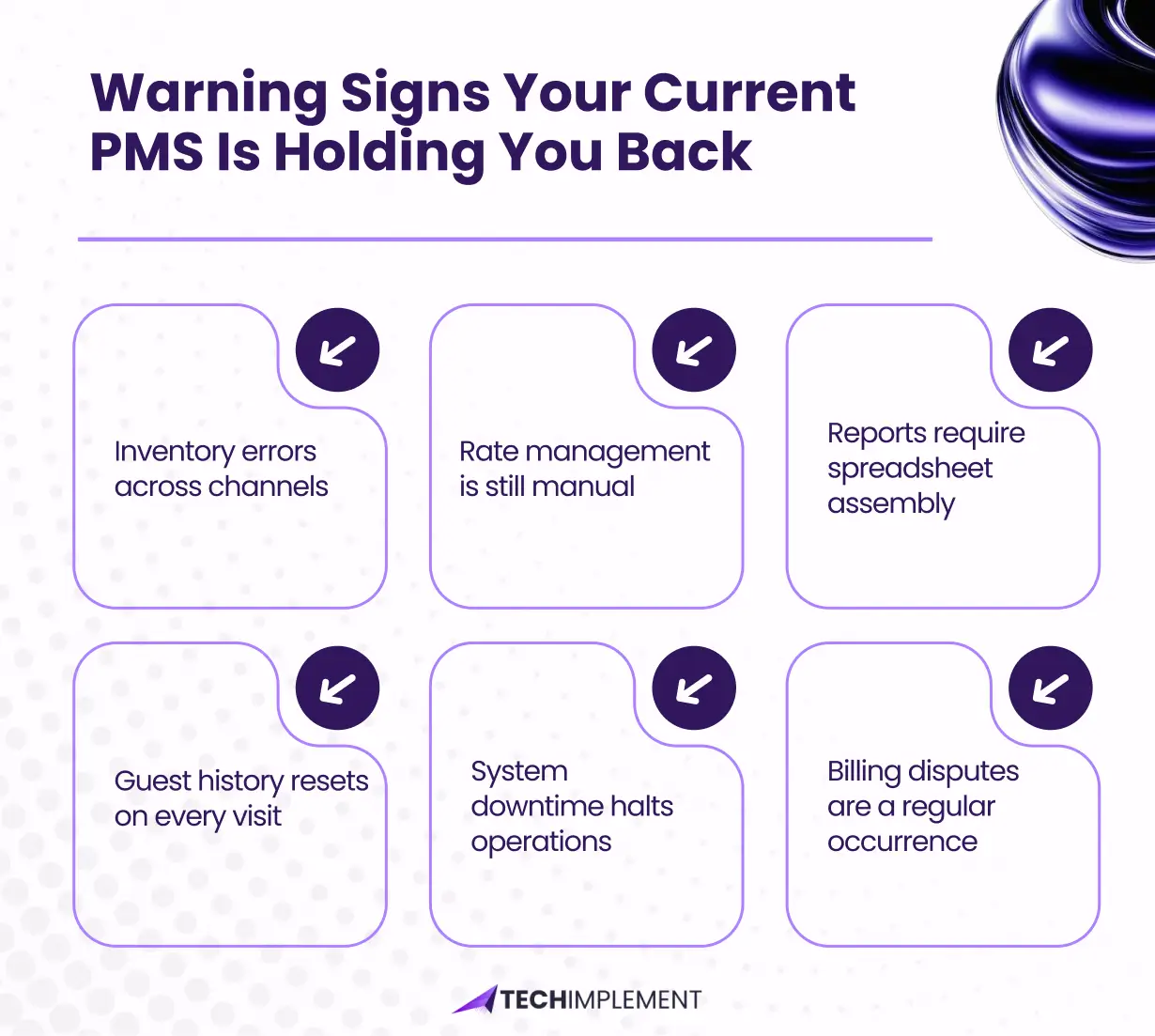
Many hotels continue operating on systems they have long outgrown. The cost of inaction is real measured in lost revenue, operational errors, and guest dissatisfaction. These indicators confirm it is time to act.
Inventory errors across channels
OTA bookings arrive for rooms already occupied because availability was not updated after a direct booking. This is a channel synchronization failure with direct financial and reputational consequences.
Rate management is still manual
Your revenue team logs into individual OTA extranets to update rates. Rate parity across channels cannot be guaranteed and almost certainly is not being maintained.
Reports require spreadsheet assembly
Generating a performance report means exporting data from multiple disconnected systems and combining it manually. Decisions are based on data that is hours or days out of date.
Guest history resets on every visit
Returning guests re-enter preferences and contact details on every stay because the system does not retain or surface their profile. Loyalty cannot be recognized or rewarded at the point of service.
System downtime halts operations
A server failure brings front-desk operations to a standstill. Staff revert to paper-based fallback procedures. This vulnerability is entirely avoidable with modern cloud infrastructure.
Billing disputes are a regular occurrence
Charges from restaurant, spa, or minibar outlets are transferred manually to the guest folio creating errors, omissions, and disputes at checkout that damage satisfaction scores and create revenue leakage.
The Future of Smart Hotel PMS Technology
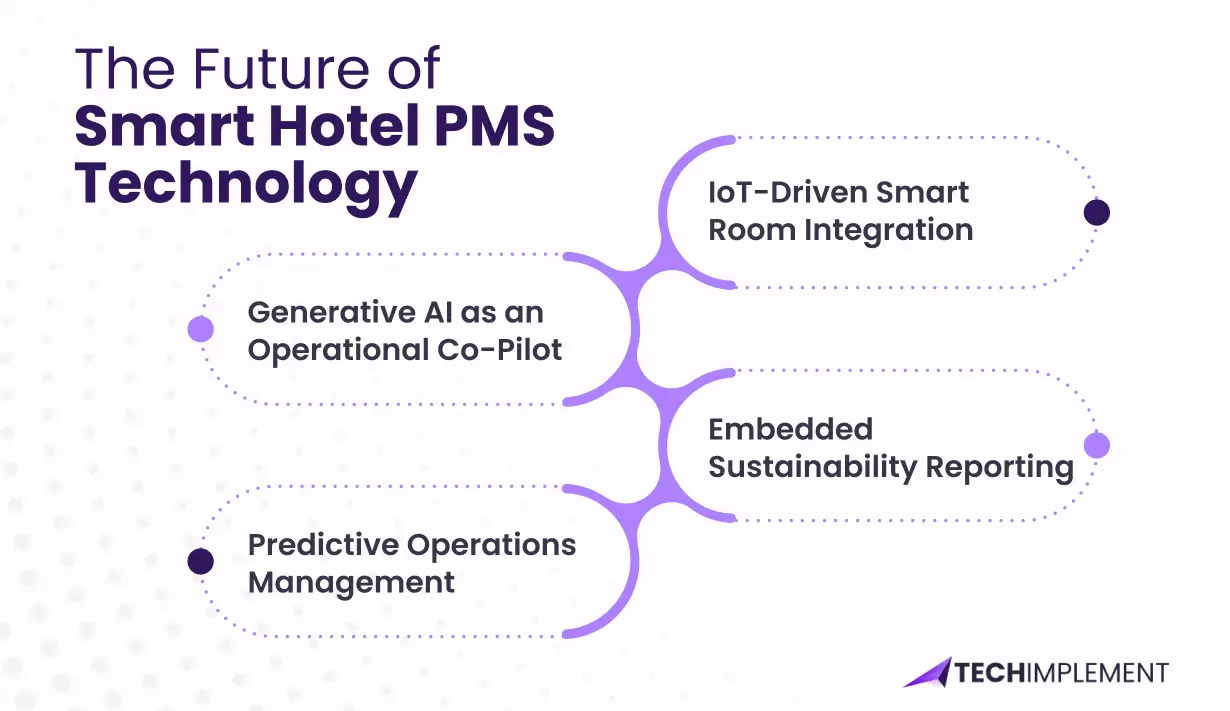
The platforms available today are significantly more capable than those of five years ago. The developments ahead are not incremental improvements; they represent a fundamental shift in how hotel operations are managed and how guest value is created.
Generative AI as an Operational Co-Pilot
Beyond revenue management, generative AI will produce guest briefings for front-desk staff before each arrival, summarizing preferences, flagging potential issues, and suggesting upselling opportunities. Revenue managers will receive AI-generated scenario models. GMs will receive daily operational summaries with specific recommended actions.
IoT-Driven Smart Room Integration
In-room climate control, lighting, entertainment settings, and access control will be automatically configured from the guest's PMS profile applied before arrival without staff involvement. For operations teams, IoT sensors will detect maintenance faults proactively, routing issues to engineering before they affect guest experience.
Predictive Operations Management
Future PMS platforms will shift from reactive to predictive management. Instead of reporting that housekeeping is running behind, the system will flag the delay hours in advance allowing managers to reallocate resources before the problem affects incoming guest arrivals.
Embedded Sustainability Reporting
Energy consumption, water usage, food waste, and carbon footprint will be tracked directly within the PMS operational interface allowing hotels to measure and manage environmental performance with the same precision applied to financial performance. Sustainability data will become a public-facing guest proposition.
Conclusion
A smart PMS is the operational architecture of your hotel business the platform on which every revenue decision is executed, every guest experience is delivered, and every performance metric is built. The quality of that architecture determines the ceiling of what your hotel achieves.
Hotels operating on smart, integrated PMS platforms are making pricing decisions using real-time AI. Their competitors are updating rates manually and hoping OTA inventory is accurate. The gap between these two operating models grows wider with every passing year.
Smart PMS investment is a business transformation one that pays for itself through reduced distribution costs, improved RevPAR, lower labor overhead, fewer operational errors, and the guest experience quality that generates repeat business rather than one-time stays.
FAQs

A traditional PMS records bookings and stores data. A smart PMS acts on that data in real time automating pricing, connecting departments, personalizing guest experiences, and surfacing live insights that drive better decisions across the entire operation.
Most cloud-based PMS platforms go live within 4 to 12 weeks depending on property size, number of integrations, and data migration complexity. Vendors with a dedicated implementation manager typically complete go-live faster with fewer disruptions.
Yes. Cloud-based smart PMS platforms are designed to scale. Small and independent properties benefit the most because they gain enterprise-grade automation, revenue management, and guest intelligence without the overhead of a large IT team or infrastructure.
By embedding a direct booking engine into the hotel website, a smart PMS captures reservations without paying OTA commissions of 15 to 25 percent. Combined with CRM-driven loyalty and personalized pre-arrival communication, it gives hotels a sustainable direct channel strategy.
Any reputable smart PMS must be PCI-DSS and GDPR compliant, with data encryption, role-based access controls, and a published breach response policy. Always verify these certifications before signing with any vendor.
Hotels typically see a 10 to 15 percent increase in Average Daily Rate through AI-driven dynamic pricing, a 17 percent lift in total revenue compared to legacy systems, and significant labor savings through automation with most properties recovering implementation costs within the first operating year.