Data Fragmentation: The Hidden Challenge in Modern Data Management
Discover how data fragmentation impacts businesses, blocks AI, and creates chaos—learn strategies to manage and unify your data effectively.
Contact Us
Businesses today are generating more data than at any point in history. Yet most of it is silently working against them, scattered, siloed, and impossible to use effectively.
Up to 80% of enterprise information is locked in unstructured formats across disconnected systems , making it the primary obstacle to AI initiatives and informed decision-making.
According to IBM's 2026 data trends report, up to 90% of enterprise data is locked away in unstructured silos leaving organizations without unified access to the information they need to compete and grow.
Gartner confirms that 57% of organizations report their data is not AI-ready, while global data and analytics spending approaches $420 billion by 2026, according to IDC.
The cause behind both problems is data fragmentation. It builds silently through every new tool adopted, every department working independently, and every data copy made without a governance plan. This article covers what it is, why it happens, how to detect it, and exactly how to fix it.
What is Data Fragmentation?
Data fragmentation occurs when an organization's data becomes scattered across different systems, applications, storage locations, and cloud environments, making it difficult to access, manage, and analyze as a whole.
It is not simply a storage problem. It is a system-wide challenge. Each system may work perfectly on its own. The problem emerges when no single team or tool can bring all of it together when a business decision requires it.
Think of it this way every department has built its own private library with different shelving systems, different labels, and different languages. Each shelf functions independently. But the moment someone needs information that connects across all of them, the entire system breaks down.
Ungoverned data fragmentation creates inefficiencies, degrades performance, and directly interferes with business operations at every level.
Data Fragmentation vs Data Silos: What Is the Difference?
These two terms are often used interchangeably but they are not the same thing. Understanding the distinction helps organizations diagnose the right problem.
Data Silos
This issue is a specific cause of fragmentation. A silo exists when a department or system isolates its data and prevents it from being shared. It is a localized problem with a clear boundary.
Data Fragmentation
This is the broader organizational consequence. It is what happens when multiple silos, uncontrolled data copies, incompatible systems and poor governance accumulate, resulting in data that is scattered, inconsistent and inaccessible at scale.
The practical difference: eliminating one silo reduces fragmentation but does not resolve it. Addressing fragmentation requires a systematic approach that tackles governance, architecture, and organizational behavior not just individual silos in isolation.
Types of Data Fragmentation
Fragmentation does not look the same in every organization. It takes four distinct forms, each requiring a different approach to address.
Physical Fragmentation
This occurs when data is scattered across different locations or storage devices across on-premises servers, multiple cloud environments, or edge devices..
Logical Fragmentation
This happens when multiple versions of the same data exist across different systems. Over time, those versions diverge and there is no longer a single source of truth anywhere in the organization.
Semantic Fragmentation
It happens when different teams define the same data differently. For example, one team calls a customer by ID while another uses the account number. The systems are connected, but they cannot understand each other.
Organizational Fragmentation
It develops when departments build their own data solutions without coordination, making it extremely difficult to share information across teams and undermining enterprise-wide consistency.
What Causes Data Fragmentation?
Fragmentation rarely happens overnight. It builds through both technical decisions and organizational behaviors, often simultaneously and without anyone noticing until the consequences are visible.
Technical Causes
Explosive Application Growth
Businesses now manage an average of 130 SaaS apps, with enterprises of over 1,000 employees averaging 200 to 300 or more. Every disconnected tool becomes a new data island.
Unstructured Data Overload
Around 89% of organizations have adopted multi-cloud strategies, with an average of 4.8 different cloud providers, and 80% embrace hybrid models, confirming that fragmented multi-environment storage is now the enterprise standard.
Uncontrolled Data Copying
Organizations copy data for valid reasons: backup, testing and analytics. But each copy creates another version that drifts from the original. Over time, inconsistencies multiply until no copy can be trusted.
Legacy System Incompatibility
Legacy systems use outdated formats that cannot communicate with modern tools. Integrating them is prohibitively expensive, leaving them as permanent data islands inside the organization.
Organizational Causes
Absence of Data Governance
Without clear policies on how data should be collected, stored and shared, data grows in whatever direction is most convenient for each team. Convenience and consistency are rarely the same thing.
Departmental Data Hoarding
Teams feel ownership over their data and resist sharing it. Marketing, sales and operations each run separate platforms with no connection and no one is accountable for the gaps between them.
Reactive Technology Adoption
Each new tool adopted independently becomes another isolated data silo. Speed of adoption without integration planning is one of the most common causes of fragmentation in 2026.
Mergers and Acquisitions
Acquired companies often rely on databases that format information entirely differently from the acquirer, making data sharing immediately difficult and hindering operational integration.
Real World Example
A leading manufacturing business had financial operations on one ERP. Production tracking runs on a separate platform. Customer relationships are managed in a third CRM. The warehouse still runs on a legacy system built ten years ago.
When the leadership team requests a complete view of operational performance, no single system can provide it. Analysts spend days manually pulling data from four separate sources and reconciling conflicting figures.
By the time the report is delivered, it is already outdated. Decisions get made on incomplete information. Opportunities get missed. And the business falls behind competitors who solved this problem years ago.
That sales forecast is missing 40% of pipeline data. The customer health scores the success team relies on are blind to over half of all customer interactions. This is what data fragmentation looks like in practice.
How to Detect Data Fragmentation
Most organizations do not realize how fragmented their data is until the consequences are already affecting the business. These are the key signals to identify before reaching that point.
Technical Detection Signals
Organizational Detection Signals
Business Impact of Data Fragmentation
The true cost of data fragmentation extends far beyond IT complexity. It affects every business function that depends on data.
Broken Decision Making: When data is scattered and inconsistent, there is no reliable single source of truth. Fragmentation forces leaders to spend time reconciling metrics instead of acting. Manual reporting slows decisions and introduces risk.
Wasted Operational Time: Employees waste significant working hours searching for data across disconnected systems. Customer service resolution times increase because agents lack a unified view, directly impacting satisfaction and retention.
Blocked AI Initiatives: AI adoption exposes gaps in data quality and governance that hinder strategic initiatives. Organizations failing to address these gaps find their AI investments delivering far below expected return.
Escalating Infrastructure Costs: Redundant pipelines, inconsistent datasets and high infrastructure costs from transferring data across disconnected systems generate direct and compounding financial losses every quarter.
Security and Compliance Exposure: Fragmented data creates a wider attack surface. Data stored across dozens of disconnected systems is significantly harder to secure, monitor, and protect from unauthorized access.
Industry-Specific Impact of Data Fragmentation
Data fragmentation does not affect every industry equally. The consequences vary significantly depending on where data gaps occur and what decisions depend on them.
Healthcare
Fragmented patient records across hospital systems, specialist platforms, and pharmacy databases lead to misdiagnosis, duplicate services, and medication errors with consequences measured in patient outcomes, not just operational costs.
Financial Services
Fragmented data requires finance teams to spend additional time reconciling and verifying data across systems before it can be used, adding delays and inefficiencies to every process from payroll to regulatory reporting.
Retail and E-Commerce
Inventory information divided across different systems makes accurate stock levels nearly impossible to maintain; certain locations become overstocked while others experience stock-outs, damaging revenue and customer experience.
Manufacturing
Fragmented production, supply chain and quality control data prevent manufacturers from identifying inefficiencies across the end-to-end operation, forcing decisions without the complete picture required to optimize them.
The Role of AI in Solving Data Fragmentation
In 2026, the relationship between AI and data fragmentation runs in both directions. Fragmentation blocks AI from working effectively. And AI is now one of the most powerful tools available for eliminating it.
Automated Data Discovery
AI scans all systems automatically mapping where data lives, how it flows and where inconsistencies exist. Work that previously required months of manual engineering can now be completed in days.
Real-Time Anomaly Detection
Machine learning models continuously monitor data quality across all environments, flagging duplicates, inconsistencies, and gaps as they emerge rather than during periodic manual reviews.
Intelligent Integration
AI-powered tools like Informatica, MuleSoft, Microsoft Azure Data Factory, Talend, and IBM Watsonx. data automatically transforms and synchronizes data across disparate systems Activebs eliminating the manual integration bottleneck that consumes so much IT capacity today.
Predictive Governance
AI identifies patterns in data growth and system behavior to predict where fragmentation is likely to develop next allowing governance teams to act before problems escalate into operational crises.
6 Strategies to Solve Data Fragmentation
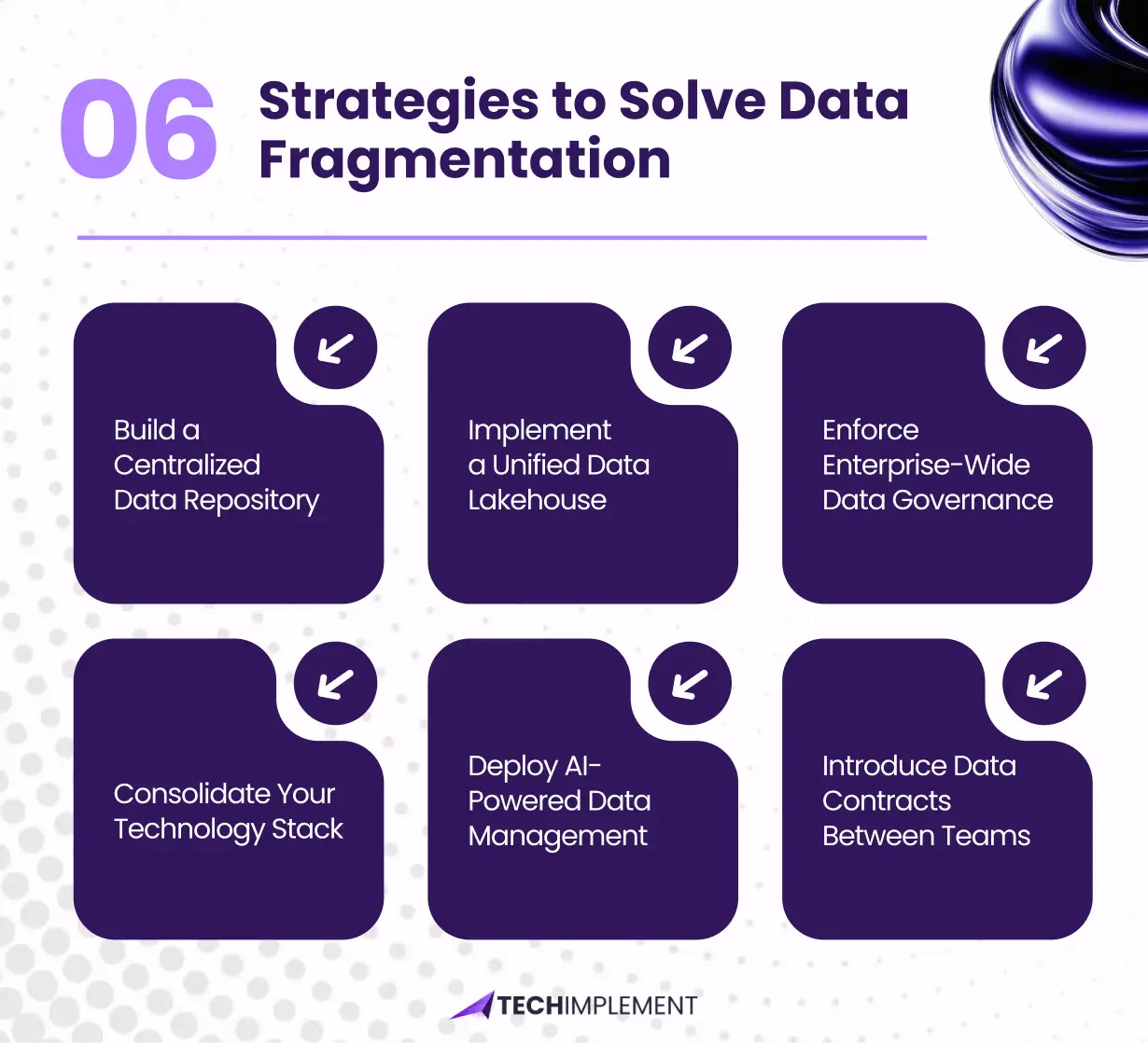
Build a Centralized Data Repository
Create a single hub that all systems connect to. Every team accesses the same version of data, simultaneously eliminating conflicting copies without requiring manual reconciliation between systems.
Implement a Unified Data Lakehouse
It combines the flexibility of a data lake with the structure of a data warehouse. Handles all data types in one environment built on open formats, eliminating architectural separation that forces incompatible systems.
Enforce Enterprise-Wide Data Governance
Define who owns each data source, who can access it and how quality will be maintained. Ongoing monitoring, AI-driven anomaly detection and periodic audits prevent fragmentation from returning after being addressed.
Consolidate Your Technology Stack
Replace disconnected point solutions with unified platforms that support open standards and interoperability. Fewer tools mean fewer data islands and significantly less integration complexity to manage over time.
Deploy AI-Powered Data Management
Automate data quality monitoring, anomaly detection, and integration continuously. This removes the human bottleneck, ensuring consistency is maintained in real time rather than during manual reviews that always lag behind growth.
Introduce Data Contracts Between Teams
Formal agreements that define exactly what format, structure, and quality standard each data source must meet before other teams consume it. Contracts turn governance from a written policy into an enforceable standard.
How to Measure Progress Key KPIs
Fixing data fragmentation without measuring progress means not knowing if the fix is working. These are the metrics that matter:
Benefits of Resolving Data Fragmentation
Addressing data fragmentation delivers measurable value across every business function, not just IT.
Single Source of Truth: Centralized governed data eliminates conflicting versions, giving every team the same reliable foundation for analysis, planning and reporting.
Faster Business Decisions: When all data is accessible and connected, patterns emerge that were previously invisible. Decision speed and confidence both improve, shifting focus from gathering data to acting on it.
Direct Cost Savings: Eliminating duplicate storage, redundant pipelines and manual integration work generates compounding savings. B2B companies that master integrated data channels see significantly higher EBIT growth than fragmented peers.
AI that Delivers ROI: Unified governed data is the prerequisite for every AI initiative. Without it, AI investments consistently underdeliver because even the most advanced model cannot compensate for incomplete data underneath.
Stronger Compliance: Governed data makes audit trails complete, privacy controls enforceable, and regulatory reporting straightforward, transforming compliance from a recurring crisis into a managed process.
Cross-Team Alignment: When silos come down, teams gain shared visibility. Decisions that previously required days of cross-departmental data chasing begin happening in minutes.
Conclusion
Data fragmentation is not a technical footnote. It is a strategic liability that silently degrades every decision, inflates every cost and blocks every AI initiative built on disconnected data.
A 2026 enterprise AI report confirms that 70% of organizations say siloed data and weak governance are their primary obstacles and 48% lack AI-ready data entirely. IDC estimates fragmented data costs businesses up to 30% of annual revenue. The scale of the problem is no longer deniable. (Source: HPCWire, March 2026) (Source: IDC via RudderStack)"
The organizations winning in 2026 are those that have done the foundational work, breaking down silos, unifying their data estate, and building a single reliable engine that every team, every tool and every AI initiative can draw from with confidence.
Unified data does not just improve operations. It changes what a business is fundamentally capable of achieving.
FAQs

Data silos are one specific cause of fragmentation. Fragmentation is the broader organizational result of scattered, inconsistent and inaccessible data caused by accumulated silos, copies and incompatible systems working together over time.
Not every form of separation is harmful. Intentional separation for performance or compliance reasons is architecturally sound. The problem arises when fragmentation is unplanned, ungoverned and creates inconsistency that directly affects business decisions.
AI requires clean, consistent and well-governed data to function reliably. Fragmented data means missing context, unreliable training data and outputs that cannot be trusted, which is precisely why most AI pilots stall before reaching production.
Start with visibility. Map where your data lives, how it flows and where the inconsistencies are. A data governance audit combined with data lineage tooling provides the complete foundation for any effective remediation plan.
Focused environments with clear ownership show measurable improvement within three to six months. Complex multi-system enterprises typically work on an 18 to 24 month consolidation timeline, starting with the highest-impact data domains first.