10 Powerful CRM Trends Every Smart Business Needs In 2026
Learn the 10 CRM trends every smart business needs in 2026, from AI-driven automation and modular CRM to privacy compliance and sales productivity.
Contact Us
Customer Relationship Management has evolved beyond simple contact storage into intelligent business systems that predict behavior, automate workflows, and deliver personalized experiences at scale. The global CRM market is projected to exceed $100 billion by 2030, with organizations reporting an average return of $8.71 for every dollar spent on implementation according to Nucleus research.
Today's customers expect instant responses, personalized interactions, and seamless experiences across all touchpoints. Understanding emerging CRM trends helps businesses stay competitive and consistently deliver exceptional customer experiences while overcoming challenges like data silos and disconnected systems.
Key Takeaways
Why CRM Trends Matter in 2026
Customer expectations have reached unprecedented heights in 2026. People demand immediate assistance, personalized recommendations, and frictionless experiences regardless of communication channel. Companies using advanced CRM features report 27% higher retention rates and 32% improved conversions compared to competitors using legacy systems.
The challenge is choosing which trends to prioritize with limited budgets and resources. This guide helps you identify which CRM trends deliver the highest value for your specific business situation through strategic implementation aligned with actual customer needs. Learn more about the Automotive CRM for winning more sales.
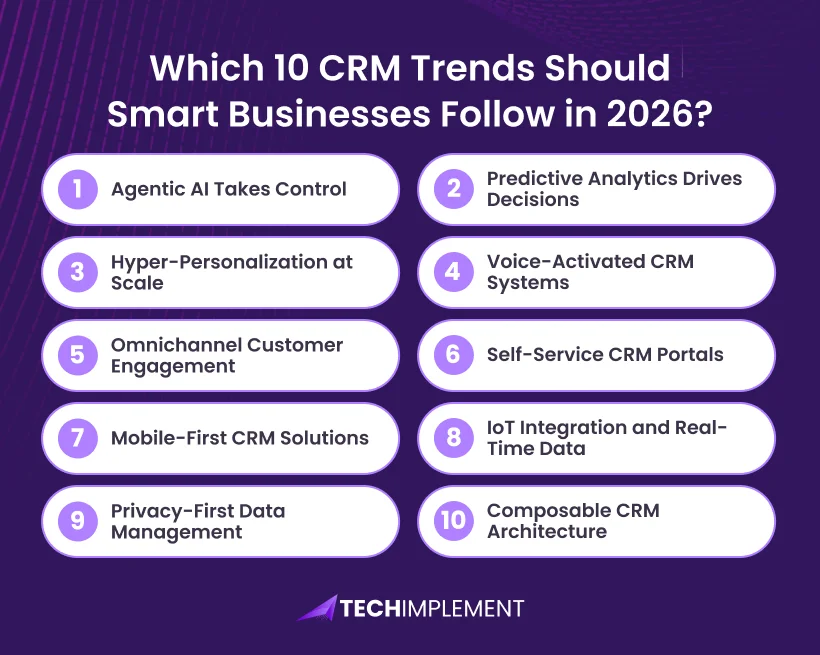
Which 10 CRM Trends Should Smart Businesses Follow in 2026?
Explore the top 10 CRM trends shaping 2026, including AI-powered automation, modular platforms, data privacy, user adoption, and investment priorities. Learn how these trends impact lead management, customer engagement, sales forecasting, and overall business growth.
1. Agentic AI Takes Control
Artificial intelligence has evolved beyond automation to achieve true autonomy in CRM systems. Agentic AI makes independent decisions, manages interactions, and optimizes sales strategies while handling lead scoring, segmentation, and personalized outreach automatically. Sales teams focus on relationships while AI analyzes patterns and predicts behaviors with remarkable accuracy.
Implementation begins with narrow use cases like automated lead qualification, showing results within 2-3 months. Platforms like Salesforce Einstein, Microsoft Dynamics 365 AI, and HubSpot offer accessible entry points starting from built-in features to custom enterprise solutions.
2. Predictive Analytics Drives Decisions
Predictive analytics transforms historical data into actionable future insights with accuracy rates exceeding 85%. Advanced algorithms identify which prospects convert, when customers might churn, and what products they'll purchase next, enabling marketing teams to reduce wasted ad spend by up to 40%.
Tools like Salesforce Einstein Analytics and Microsoft Power BI require 6-12 months and substantial historical data before consistent accuracy. Start with one specific outcome like churn prediction rather than comprehensive forecasting, with costs justified when handling high-value customers.
3. Hyper-Personalization at Scale
Hyper-personalization uses AI to customize every interaction based on preferences, behaviors, and real-time context like location or browsing activity. Systems analyze thousands of data points to recommend products, send communications at optimal times, and adjust content dynamically, with businesses reporting 20-30% conversion increases.
Platforms like Adobe Experience Cloud, Salesforce Marketing Cloud, and HubSpot offer personalization engines from under $100 monthly for small businesses to enterprise solutions serving millions. The key is balancing relevance with privacy to avoid invasive experiences.
4. Voice-Activated CRM Systems
Voice technology revolutionizes CRM interaction as representatives update records, schedule follow-ups, and retrieve information using simple commands without keyboards. This reduces data entry time by 60% while improving data quality through immediate updates during customer conversations.
Integration with Alexa for Business and Google Assistant enables hands-free operation ideal for mobile users and field sales teams. Most major CRM platforms include basic voice capabilities at no additional cost, with adoption being the main barrier rather than technology.
5. Omnichannel Customer Engagement
Omnichannel CRM unifies email, social media, phone, chat, and messaging apps into single customer views accessible organization-wide. Representatives see complete histories across channels, enabling contextual conversations that reduce handling time by 25-30% and improve first-contact resolution rates significantly.
Platforms like Zendesk, Salesforce Service Cloud, and Microsoft Dynamics 365 offer comprehensive capabilities starting around $50-75 per user monthly. Implementation requires integrating disparate systems and prioritizing channels based on actual customer preferences rather than attempting universal presence.
6. Self-Service CRM Portals
Self-service portals provide knowledge bases, AI chatbots, and community forums that answer questions instantly 24/7, reducing support costs by 40% and ticket volume by 30-50%. Customers access account management, order tracking, and troubleshooting whenever convenient while support teams focus on complex issues.
AI chatbots handle 60-70% of common inquiries using platforms like Zendesk, Freshdesk, and ServiceNow. Budget $10,000-50,000 for initial setup including content creation, with ongoing costs of $1,000-5,000 monthly delivering ROI within 6-12 months through reduced staffing needs. .
Learn more about the crm software for car dealerships
7. Mobile-First CRM Solutions
Cloud-based mobile CRMs provide full functionality on smartphones and tablets with touchscreen-optimized interfaces and real-time synchronization, increasing productivity by 25-35%. Representatives access customer histories, update opportunities, and collaborate from anywhere with offline functionality that syncs automatically when connection restores.
Salesforce Mobile, Microsoft Dynamics 365 Mobile, and HubSpot Mobile require no additional licensing beyond standard subscriptions. Success depends on adapting workflows for mobile environments rather than forcing desktop processes onto smaller screens through early field team involvement.
8. IoT Integration and Real-Time Data
Connected IoT devices send performance metrics, usage patterns, and maintenance alerts directly to CRM systems, enabling proactive service before customers notice problems. Sales teams identify upsell opportunities from usage data while marketing triggers campaigns based on product milestones, transforming CRM into real-time customer situation understanding.
Platforms like Salesforce IoT Cloud and Microsoft Azure IoT handle integration with costs of $5-10 per device monthly for simple implementations. ROI comes from reduced service costs and improved retention, with pilot programs recommended before broad expansion.
9. Privacy-First Data Management
Privacy-first CRM prioritizes transparent data collection, secure encryption, and customer control over personal information to comply with GDPR, CCPA, and global regulations. Modern systems include consent management, automated retention policies, and customer portals for viewing or deleting data, building trust while avoiding penalties reaching millions.
Platforms like OneTrust and TrustArc help manage complexity with small businesses spending $5,000-15,000 for compliant processes while enterprises invest substantially more. Privacy-first approaches mean collecting only necessary data and providing genuine customer control beyond checkbox compliance.
10. Composable CRM Architecture
Composable architecture allows businesses to select best-in-class specialized tools rather than accepting all-in-one platform compromises. Companies swap individual components without replacing entire systems using integration platforms like Zapier, Workato, and MuleSoft to maintain unified customer views across applications.
This modular approach suits mid-market and enterprise companies with specific requirements, though increased complexity requires technical capability for managing multiple vendors. Start with a solid core CRM, then add specialized tools for specific gaps rather than comprehensive immediate customization.
Conclusion
CRM trends in 2026 emphasize intelligence, personalization, and customer empowerment through advanced technology integration. Businesses adopting these innovations gain competitive advantages through improved understanding, efficiency, and relationship quality when aligned strategically with customer needs and business objectives
Start with trends delivering immediate value for your situation rather than implementing everything simultaneously. Small businesses should focus on mobile access and basic automation, mid-market companies benefit from predictive analytics and omnichannel integration, while enterprises leverage comprehensive implementations. Choose wisely, implement thoughtfully, and measure results continuously to ensure CRM investments deliver promised value.
Frequently Asked Questions

Training and user adoption represent the biggest hurdles, with 25% of businesses identifying these as primary challenges. Research shows 43% of businesses use less than half their CRM features, and 22% of sales professionals remain unsure what CRM actually is. Combat this through role-based training programs and demonstrating immediate value to frontline users.
Beyond software costs, plan for comprehensive expenses. Data migration and cleanup typically consume 15-20% of total budgets, while integration work requires another 20-30%. Training programs need dedicated funding, and many companies underestimate ongoing support costs. Failed CRM projects between 20-70% often stem from insufficient resource allocation during implementation.
Small businesses gain significant advantages since 79% of CRM users recognize AI's importance in sales tools. AI personalizes interactions, streamlines processes, and drives growth even for smaller teams. However, 32% cite lack of technical expertise as a barrier. Choose platforms with intuitive AI features requiring minimal technical knowledge.
Implementation timeframes vary based on organizational complexity and existing systems. Companies with clean data and clear processes move faster, while those migrating from multiple legacy systems need extended timelines. Most failures occur from rushed deployments without proper planning. Allocate sufficient time for comprehensive user testing before full rollout.
Key indicators include 32% of sales reps spending over one hour daily on manual data entry, showing automation gaps. If customer data is incomplete or inaccurate according to one-third of sales leaders, your system fails its core purpose. Watch for teams creating spreadsheet workarounds instead of using the CRM.
Poor data quality costs companies 15-25% of annual revenue through wasted spend and missed opportunities. Combat this by implementing automated data capture systems minimizing manual entry, establishing data governance policies, and conducting regular quality audits. Average CRM adoption rates of just 26% compound data problems when users avoid the system.
The answer depends on your technical capabilities and business needs. While 90% of businesses don't fully utilize CRM solutions, composable systems require even higher technical sophistication to manage effectively. All-in-one platforms offer simplicity but may include unused features. Assess your team's ability to manage multiple integrations before choosing.
Companies experience 17% increases in lead conversions, 16% boosts in customer retention, and 21% rises in agent productivity with CRM adoption. However, these benefits only materialize with proper usage. Sales teams report 41% revenue increases when leveraging CRM effectively, but success requires moving beyond basic contact management to strategic utilization.
Compliance requirements extend beyond GDPR and CCPA to industry-specific regulations. Healthcare needs HIPAA compliance, education requires FERPA adherence, and financial services face additional data protection mandates. Violations carry severe penalties, with GDPR fines reaching 4% of global revenue. Ensure your CRM includes consent management and automated compliance tracking.
Modern CRMs prioritize integration, but 17% of businesses identify lack of integration with other tools as a major challenge. Before purchasing, verify specific integrations needed for your tech stack work bi-directionally with real-time data sync. Poor integration is among the top reasons for CRM project failure, alongside adoption and training issues.