2026 ERP Revolution: Top Trends Small Businesses Can’t Ignore
Explore the top ERP software trends for small businesses must follow in 2026 to boost efficiency, streamline operations, and stay ahead of the competition.
Contact Us
Enterprise Resource Planning (ERP) systems are no longer tools of only big businesses. It has become a fundamental part of how even small businesses function on a day-to-day basis, overseeing accounting, inventory, sales, human resources, customer service, and more. With the passing of each day, ERP systems are more intelligent, user-friendly, and cost-effective.
2026 will be a special year for small business ERP solutions . AI, automation, IoT, cloud-related systems, and other modular technologies will revolutionize how small businesses structure, manage and grow. The goal of this article is to outline these future changes in the simplest, most comprehensive manner to help small business owners foresee and prepare for the future.
Why 2026 Is a Critical Year for ERP Evolution
2026 marks the year when several major technologies mature at the same time:
Because of the synchronized output of innovations, ERP systems will evolve at an unprecedented rate. The first small businesses to embrace the advancements will experience a heightened competitive edge in cost, speed, decision-making, and customer satisfaction.
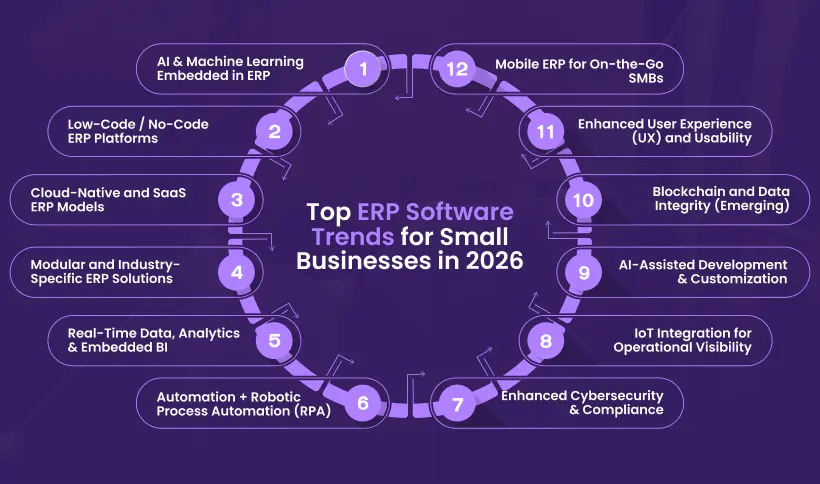
Top ERP Software Trends for Small Businesses in 2026
The coming years will see ERP systems become smarter, more connected, and easier to use. Here are the top trends that will define the ERP landscape for small businesses.
AI & Machine Learning Embedded in ERP
AI is no longer something “extra.” By 2026, it will become a built-in feature that functions in the background to facilitate daily business activities.
What this means for small businesses
Why this matters
AI permits small groups to perform the tasks of a large corporation without the need for extra employees and complicated systems.
Low-Code / No-Code ERP Platforms
These platforms give small businesses the ability and freedom to customize their ERP without the need to hire IT professionals.
What that means
Why that’s important
Small businesses almost never function the same way. Low-code/no-code ERP brings flexibility to SMEs so they can change and respond to new opportunities or challenges.
Cloud-Native and SaaS ERP Models
When ERP systems are fully developed in the cloud, systems are considered Cloud-Native. SaaS ERP systems are deployed in public, private, or hybrid cloud configurations. Both cloud systems offer security, system updates, and performance advantages.
Benefits for small businesses
Why it matters
Small businesses receive a cloud-native ERP for predictable costs and access to enterprise-class technology, which was previously only available to larger businesses.
Modular and Industry-Specific ERP Solutions
ERP is beginning to move away from the “one size fits all” approach. For the most part, businesses are selecting only the modules they actually need.
Some examples of modules are:
Industry Specific Versions
Specialized ERP systems tailored for:
Why small businesses stand to benefit
Real-Time Data, Analytics & Embedded BI
In 2026, ERP systems focus heavily on real-time information.
What Real-Time ERP Systems Can Offer
Why It Matters
Small businesses are better equipped to know the complete picture of what is happening right now. More informed decisions can be made and surprises will be minimized.
Automation + Robotic Process Automation (RPA)
RPA does repetitive tasks, taking over monotonous work and streamlining processes so they run quicker and are more reliable.
What it Automates
Why it's important
RPA is an essential technology. With it, small businesses can save valuable time and improve the overall operational efficiency in their business.
When the office is closed, AI and RPA continue to work in the system. These two work together in a seamless manner to allow for continuous productivity to occur.
Enhanced Cybersecurity & Compliance
As more business data moves online, security is a priority.
Modern ERP security features
Why this matters
Small businesses often lack full-time IT security staff.
2026 ERP systems provide enterprise-level protection automatically.
IoT Integration for Operational Visibility
IoT devices like scanners, sensors, or tracking systems connect directly with ERP.
How it helps businesses
Why small businesses benefit
In this case, IoT plus ERP enables small to medium organizations to have seamless real-time visibility on the movement of products and processes.
AI-Assisted Development & Customization
In 2026, ERP systems will help write code or configure features more easily by using AI tools as well.
What this means
AI will serve as a digital assistant for developers as well as limited technical users.
Blockchain and Data Integrity (Emerging)
While still developing, blockchain in ERP is becoming useful for data verification and supply chain transparency.
Practical uses
Why is this important
There is a potential to develop trust with clients and partnerships in a small business with verified and transparent data.
Enhanced User Experience (UX) and Usability
Current ERPs have a focus on modern designs and user-centric systems.
What this looks like
Why it matters
Higher user adoption and lion frustrations change and remove frustrations of training to be on the same (lower) level as other users. More smooth training can be implemented with processes that utilize higher levels of automation.
Mobile ERP for On-the-Go SMBs
Mobile access becomes essential, not optional.
What businesses can do from mobile?
Why small businesses need this
Work doesn’t always happen in an office.
Mobile ERP keeps the business running smoothly from anywhere.
GREEN ERP Initiatives
Sustainability is becoming important for both regulations and brand reputation.
Green ERP features
Why this matters
Small businesses can operate more efficiently while also showing commitment to environmental responsibility.
How Small Businesses Can Get Ready for the Trends
It is easy to get your small business ready for the Future of ERP. The focus for your small business is on how to efficiently implement some actionable steps and make sure the new system really helps you achieve your goals.
1. Conduct a needs assessment
Identify which processes slow your business down or need improvement.
2. Choose vendors offering modern ERP features
Look for AI, automation, modularity, and cloud-native design.
3. Start small, scale later
Begin with essential modules, then expand when ready.
4. Invest in training and change management
Make sure your team understands how to use the new system.
5. Strengthen governance
Prepare strong policies for data security, compliance, and usage.
Conclusion
The deployment of AI, cloud-native ERP systems, automation, real-time analytics, and intuitive user interfaces will profoundly alter and enhance ERP and small business operations in 2026. These changes will greatly increase the operational and decision-making efficiency of small businesses, enabling them to compete against bigger firms.
Small businesses that prepare will benefit from accelerated growth, enhanced operational strength, and a wide competitive gap. The future of ERP and these operational systems is designed to be user-friendly, intelligent, and focused on businesses of all sizes, especially the small firms.
FAQs

Modern ERPs are cloud-native, AI-powered, modular, and low-code. This makes them easier to adopt, faster to customize, and more affordable, something older systems could not offer.
AI automates routine tasks, reduces errors, predicts demand, and provides real-time insights. This helps small businesses make quicker, smarter decisions without hiring extra staff.
They offer lower upfront costs, automatic updates, remote access, and built-in security. Small businesses get enterprise-grade technology without needing large IT teams.
Modular ERP lets companies start with essential features and add more when needed. This avoids high initial spending and ensures the system scales as the business grows.
Yes. Low-code/no-code tools let employees customize workflows, forms, and automations through simple interfaces no programming skills required. This increases adoption and reduces IT dependency.
They should assess their needs, check vendor capabilities (AI, modularity, cloud), plan for scalability, train staff, and establish strong data governance to ensure long-term success.